Sermons

Welcome to our Sermons page—here you'll find a collection of messages shared at Living Waters Church to encourage, challenge, and strengthen your faith. Each sermon is accompanied by a Sermon Guide to help you engage more deeply with the teaching. These Sermon Guides include:

  • Scriptures to read and reflect on

  • A clear recap of the sermon’s main points

  • Memorable quotes, sayings, or “aha” moments

  • Questions for discussion in small groups or personal study

  • Suggested resources for deeper exploration

  • Prayer points inspired by the message

Let the Word shape you as you listen, reflect, and grow.

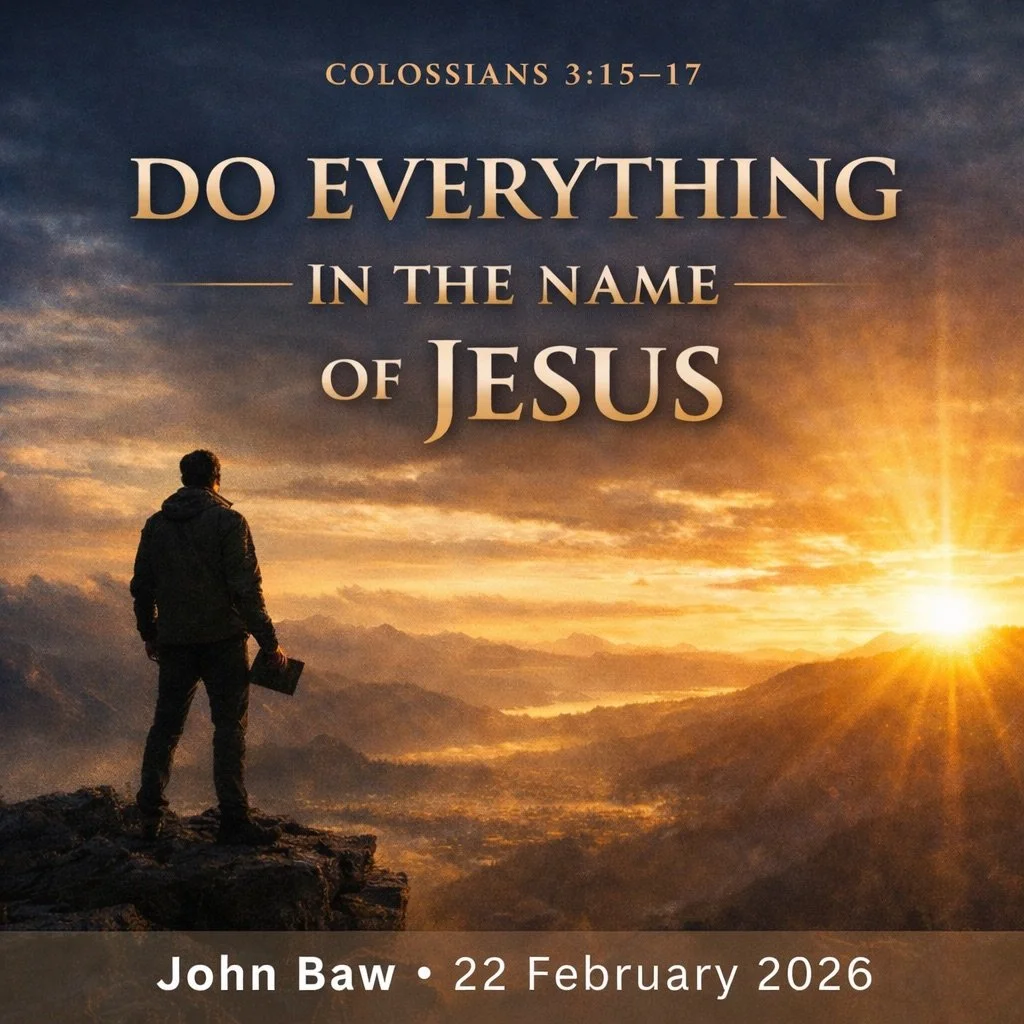
Sermon: Do Everything in the Name of Jesus

LWC SERMON GUIDE

Do Everything in the Name of Jesus

Scriptures to read and ponder

Main teaching text: Colossians 3:15–17


Other scriptures shared in the sermon:

  • 2 Corinthians 5:20 — “We are therefore Christ’s ambassadors…”

  • Romans 12:2 — “Do not be conformed to this world…”

  • Mark 4:38 — Jesus asleep in the storm

    Sermon Recap

    1. We are Christ’s ambassadors

    • The sermon opened with the picture of an ambassador: someone who does not carry his own authority, but the authority of the one who sent him.

    • Paul applies that picture to every believer in 2 Corinthians 5:20. This means that Christians are not merely private individuals trying to survive life. We are sent people, representing Jesus in the world.

    • A powerful pastoral image was given through the story of visiting people in hospital. Even when tired, ordinary, or worn down, the believer does not enter a room alone or in his own strength. He enters in the name of Jesus.

    • This truth was widened beyond pastors to all believers: the nurse, the teacher, the mother, the grandfather, the worker. Wherever a Christian goes, heaven has sent an ambassador.

    2. There is a quiet war for the human soul

    • The sermon highlighted that every day the world is trying to shape and disciple us.

    • Culture, social media, news, and algorithms all compete to form our thinking, values, reactions, and desires.

    • Romans 12:2 was used to show that believers must refuse to be squeezed into the world’s mould and instead be transformed by the renewing of the mind.

    • One of the sharpest warnings in the sermon was this: it is possible to have the language of faith on our lips while still carrying the values of the world in our hearts.

    • Colossae was described as a city full of competing voices, philosophies, traditions, powers, mysticism, and confusion. In that sense, it looked remarkably like our own moment.

    3. The Christian life is shaped by three simple realities

    • Paul’s vision in Colossians 3:15–17 was presented as three movements of the Christian life:

      • Peace in the heart

      • Word in the soul

      • Jesus over everything

    • This is not merely religious behaviour. It is a Spirit-formed life, a counter-cultural life, a life marked by the rule of Christ from the inside out.

    4. Let the peace of Christ rule your heart

    • The Greek word behind “rule” was explained as the language of an umpire or referee. Christ’s peace is meant to act like the deciding authority in the believer’s heart.

    • This means fear, panic, insecurity, conflict, and emotional turbulence are not meant to have the final say. Christ’s peace is to decide what stays and what goes.

    • The sermon made clear that this is not vague peace or worldly calm. It is the peace of Christ himself, the peace seen in Jesus sleeping in the storm.

    • An ambassador carries the atmosphere of the kingdom he represents. Therefore, believers carry peace into conflict, crisis, work pressure, hospitals, and family life.

    • Gratitude was presented as the soil in which peace grows. Thankfulness shifts the heart from fear to trust.

    5. Let the word of Christ dwell in you richly

    • Paul moves from the heart to the soul, from peace to truth.

    • The word “dwell” was explained as making a home, taking up residence, living there permanently. The word of Christ is not meant to be an occasional visitor but a permanent resident.

    • A striking image used in the sermon was that a visitor is entertained, but a resident rearranges the furniture. When the word of Christ truly dwells in us, it rearranges priorities, values, thinking, and identity.

    • The sermon challenged modern Christianity by noting that access to Scripture is not the same as being formed by Scripture. We may have apps, podcasts, and sermons, yet still not let the word shape us deeply.

    • This was also shown to be a corporate reality, not only a private one. When the word dwells richly in a church family, believers teach, encourage, worship, and speak truth to one another naturally.

    6. Do everything in the name of the Lord Jesus

    • The sermon reached its climax in Colossians 3:17: whatever we do, in word or deed, must be done in the name of the Lord Jesus. 2

    • “In the name of Jesus” was carefully unpacked. It is not a slogan, magical phrase, or religious formula. In Scripture, a name represents authority, representation, and acting on behalf of another.

    • To live in the name of Jesus means that all of life comes under his lordship: work, speech, relationships, decisions, responses, habits, and private conduct.

    • The Christian life is therefore not compartmentalised. It is not switched on for church and switched off afterward. It is a whole-life identity.

    • The New Testament witness to the authority of Jesus’ name was also highlighted: healing, deliverance, and salvation all unfold in his name.

    7. Final pastoral challenge

    • The sermon closed by returning to the central vision:

      • Peace of Christ ruling the heart

      • Word of Christ dwelling in the soul

      • Name of Christ governing everything

    • Believers were reminded that they do not need to be perfect or perform as “super spiritual” people. They are ordinary people carrying the extraordinary presence, authority, and commission of an extraordinary King.

  • Memorable quotes

    • “An ambassador does not walk into a room carrying his own authority. He carries the authority of the nation that sent him.”

    • “When a Christian walks into a room… heaven just sent an ambassador.”

    • “I am not walking into that room representing myself. I am walking into that room in the name of Jesus.”

    • “You may feel ordinary. But heaven has sent an ambassador.”

    • “Every day something is trying to disciple you.”

    • “You can end up with the language of faith on your lips, but the values of the world in your heart.”

    • “The great tragedy of modern Christianity is that many believe in Jesus, but not so many are being formed by Jesus.”

    • “It is time to stop visiting the Bible. It is time to let the word of Christ dwell in us richly.”

    • “You do not just believe in Jesus; you live in His name.”

    • “We are just ordinary people carrying the extraordinary presence and authority of an extraordinary King.”

  • Questions for discussion

    1. What stood out most strongly to you from today’s sermon, and why?

    2. What does it mean in practical terms to live as Christ’s ambassador in everyday life?

    3. Where do you most often feel “ordinary,” weak, tired, or inadequate? How does the ambassador picture speak into that area?

    4. In what ways is the world trying to disciple and shape you at present?

    5. Which voices are loudest in your life right now: Christ, culture, social media, fear, opinion, pressure, or something else?

    6. What does it look like for the peace of Christ to act as the referee in your heart?

    7. Are there areas where fear, anger, pressure, or anxiety are making decisions for you instead of the peace of Christ?

    8. Why is gratitude so closely connected to peace?

    9. Has the word of Christ been a visitor in your life, or a resident? Explain your answer honestly.

    10. What “furniture” might the word of Christ need to rearrange in your thinking, habits, priorities, or identity?

    11. How can our church family become more shaped by Scripture in conversation, encouragement, and worship?

    12. What are the dangers of using “in the name of Jesus” as religious language without living under his authority?

    13. What area of your life do you find hardest to bring under the name and lordship of Jesus?

    14. What would change this week if you consciously went to work, home, and public spaces as an ambassador of Jesus?

  • Further reading

    Additional Scriptures:

    • Philippians 4:6–9 — peace guarding heart and mind

    • Isaiah 26:3 — perfect peace for the steadfast mind

    • John 14:27 — “My peace I give you”

    • Psalm 119:9–16 — storing the word in the heart

    • Joshua 1:8 — meditating on the word day and night

    • 2 Timothy 3:16–17 — Scripture equipping the believer

    • Acts 3:6, 16 — power in the name of Jesus

    • Acts 4:12 — salvation in the name of Jesus

    • Ephesians 6:10–18 — standing in spiritual warfare

    • Matthew 5:13–16 — living publicly as salt and light

    • Romans 8:5–6 — the mind set on the Spirit

    • Colossians 1:9–14 — walking worthy of the Lord

    Reading resources:

    • Re-read Colossians 3 slowly in full context, especially verses 1–17

    • Read 2 Corinthians 5:11–21 to explore the ministry of reconciliation and ambassadorial identity

    • Read Romans 12 for a fuller picture of Christian formation and counter-cultural living

    • Spend time in the Gospels observing the peace, authority, and words of Jesus, especially in Mark 4 and John 14

  • Prayer points

    • Lord Jesus, teach us to live as your ambassadors in Gibraltar, carrying your presence faithfully into every room and every relationship.

    • Let the peace of Christ rule in our hearts and overrule fear, panic, insecurity, and confusion.

    • Give us settled hearts and steady minds in a noisy and anxious age.

    • Forgive us for the ways we have allowed culture more influence over us than Christ.

    • Renew our minds and free us from being squeezed into the mould of this world.

    • Let the word of Christ dwell in us richly, not as an occasional visitor but as a permanent resident.

    • Rearrange the furniture of our inner lives: our priorities, loves, habits, imagination, and identity.

    • Make LWC a community where Scripture shapes conversation, worship, encouragement, and discipleship.

    • Bring every area of our lives under the name of Jesus: our words, work, family life, private lives, decisions, and responses.

    • Fill us with gratitude, because thankful hearts become peaceful hearts.

    • Help us carry the atmosphere of your kingdom into homes, hospitals, workplaces, schools, and streets.

    • Let our church family be ordinary people carrying the extraordinary presence and authority of King Jesus.

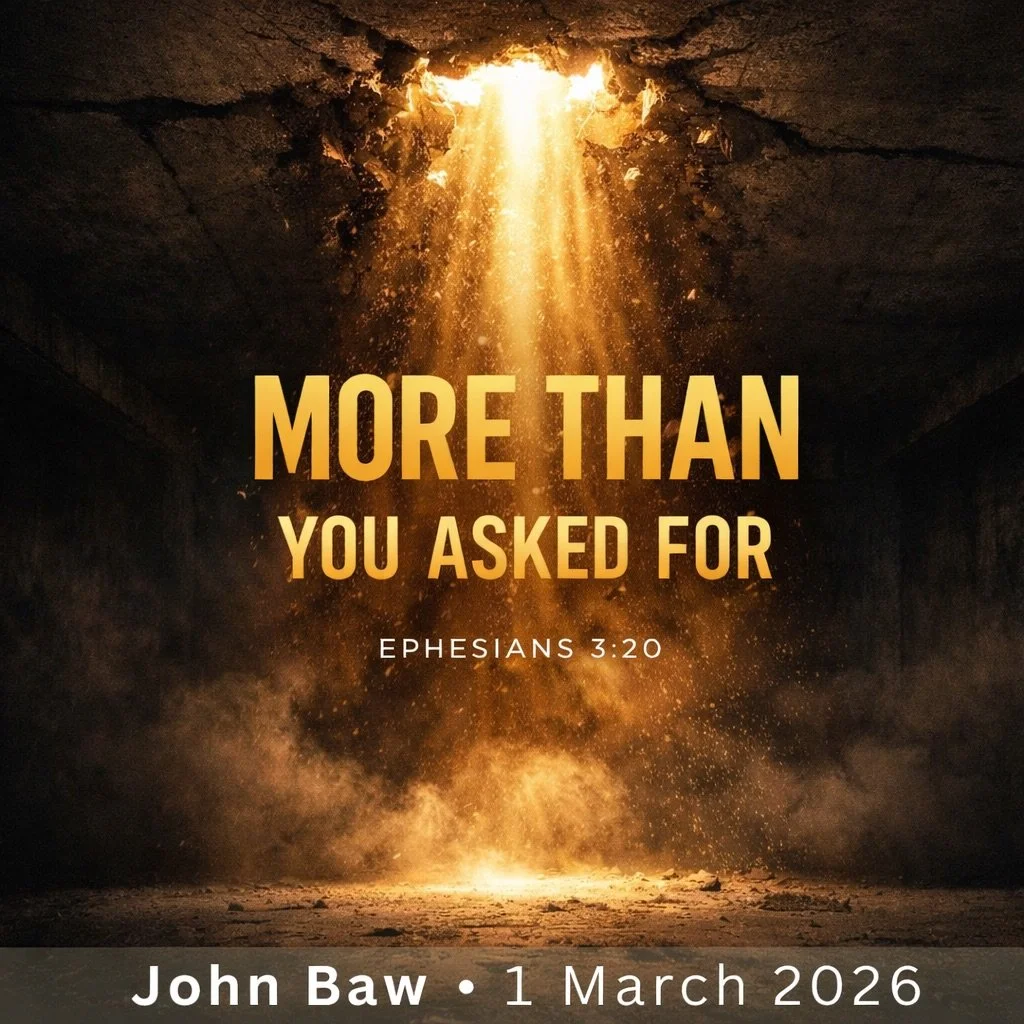
Sermon: More than you asked for

LWC SERMON GUIDE

More Than You Asked For

Scriptures to read and ponder

  • Main teaching text:

    • Ephesians 3:20–21 (NKJV)

  • Key build-up texts from the sermon:

    • Ephesians 3:14 (NIV)

    • Ephesians 3:16–18 (NIV)

    • Ephesians 1:19–20 (NIV)

    • John 7:38 (NIV)

    • Psalm 23:5 (NKJV)

    • 1 Peter 2:9 (for identity language: chosen people, royal priesthood)

    Sermon Recap

    1) The Hook: The wrong container

    • The tension is not always God’s silence or absence.

    • Sometimes the issue is our expectations: bringing a teacup to a waterfall.

    • Many prayers are “safe prayers” (cope, survive, get through) rather than faith-filled prayers that match God’s nature.

    • Core confrontation: Heaven is not contained in a teacup, and God does not operate in “just enough.”

    2) The posture before the promise: Paul kneels

    • Before Paul declares overflow (v20), he models surrender and dependence (v14).

    • Paul does not start with a strategy; he starts with a posture.

    • When he wants the church to rise, he goes low.

    • He prays for inner strengthening by the Spirit, rootedness in love, and spiritual capacity to comprehend Christ’s love (vv16–18).

    3) The capacity problem: living beneath inheritance

    • The sermon names a common pattern: settling, shrinking, thinking small.

    • The church can live beneath what heaven has already declared.

    • The prayer for “grasping” is a prayer for holy capacity: a heart enlarged to receive what God is already pouring out.

    • The point is not self-improvement; it is spiritual enlargement so we can actually receive and carry what God gives.

    4) The revelation: a God of overflow

    • The pivot is decisive: “Now unto Him…”

    • The focus is not the size of our vessel, but the source of the supply.

    • Paul stacks language to stretch the church’s imagination:

      • Exceedingly. Abundantly. Above.

    • This is not hype; it is a biblical promise anchored in God’s character and ability.

    • God does not only want people to cope; He calls them to conquer.

    5) The shocking line: the power is already working in us

    • The “earthquake” phrase: “according to the power that works in us.”

    • The sermon emphasises: this is not a power that might visit one day; it is active now.

    • The “working” language signals divine energy in motion, not theory.

    • Supporting scriptures reinforce the internal reality:

      • Rivers of living water from within (John 7:38).

      • Resurrection power at work in believers (Ephesians 1:19–20).

    • The tragedy is not a powerless heaven, but an unaware church: living as though unplugged.

    • The church does not wait for power; the church stewards power.

    6) Identity: you were not designed for small living

    • Believers carry “resurrection DNA.”

    • Identity language: chosen people, royal priesthood—royalty does not think like poverty.

    • Kingdom thinking shifts prayer targets: not crumbs, but overflow; not mere needs, but generational impact.

    • In a fragmented culture (family breakdown, confusion, anxiety), God positions the church to overflow with living water into emptiness.

    7) Conclusion: breakthrough is corporate and generational

    • Breakthrough is not private consumption; it is for God’s glory in the church (v21).

    • What God does in individuals strengthens the body: healing, deliverance, restored marriages, endurance stories.

    • The overflow moves beyond the present: to all generations.

    • The sermon closes where it began: you came with a teacup, but God is raising a river.

    Memorable quotes

    • “What if the issue is not that God is absent, but that we brought a teacup to a waterfall?”

    • “Heaven is not contained in a teacup.”

    • “God does not operate in ‘just enough.’”

    • “Paul does not begin with a strategy; Paul begins with a posture.”

    • “When he wants the church to go up, he goes low.”

    • “The emphasis is not in the size of your vessel, the emphasis is in the source of the supply.”

    • “Beyond the beyond.”

    • “There is a divine energy running through your spirit, and yet you live as though you were unplugged.”

    • “We do not wait for power. We steward it.”

    • “There is no such thing as a private breakthrough.”

    • “Breakthrough begins with you, but it does not end with you.”

    Questions for discussion

    1. Where have you been praying “cope prayers” instead of faith-filled prayers that match God’s nature?

    2. What is a current area of life where you feel you have been living beneath your inheritance in Christ?

    3. Paul begins by kneeling. What does “posture before promise” look like in your daily life this week?

    4. The sermon contrasts focusing on capacity versus focusing on God as the source. Where do you drift into self-reliance?

    5. What does “exceedingly, abundantly, above” challenge in your thinking, planning, and expectations?

    6. The sermon says the power is already at work within believers. What would change if you genuinely believed that today?

    7. What does “stewarding power” look like in practice (habits, obedience, repentance, courage, serving)?

    8. How does your identity (royal priesthood, resurrection life) confront a “poverty mindset” spiritually, emotionally, or practically?

    9. Who around you needs the “overflow” from your life right now (family, workplace, church, neighbours)?

    10. The conclusion says breakthrough is corporate and generational. How could your testimony strengthen the church family?

    11. What is one “teacup” limitation you need to repent of (small thinking, fear, control, unbelief)?

    12. What is one specific, measurable step you will take this week to enlarge your life toward God’s purposes?

    Further reading

    • Scripture threads to study:

      • The prayers of Paul (Ephesians 1:15–23; Ephesians 3:14–21)

      • The Spirit’s indwelling power (Romans 8:1–17)

      • Abiding and fruitfulness (John 15:1–11)

      • Living water and the Spirit (John 4:1–26; John 7:37–39)

      • “Ask” and “seek” in the life of faith (Matthew 7:7–11)

      • God’s generosity and “overflow” imagery (Psalm 23; Malachi 3:10; 2 Corinthians 9:6–11)

      • Identity and mission as God’s people (1 Peter 2:9–12)

    Prayer points

    • Posture and surrender

      • Father, teach me to kneel before I speak, to worship before I worry, to surrender before I strive.

    • Enlarged capacity

      • Holy Spirit, strengthen my inner being. Enlarge my heart to receive the love of Christ without shrinking back.

    • Repentance from small thinking

      • Lord, I repent for settling, for shrinking, for praying small because fear felt safer than faith.

    • Revelation of God’s nature

      • Give me a clear revelation that You are able, and that Your nature is overflow, not scarcity.

    • Awareness and stewardship of indwelling power

      • Wake me up to the power already at work within me. Teach me to steward it through obedience, holiness, and courage.

    • Identity and boldness

      • Remind me who I am in Christ. Break poverty thinking. Form Kingdom thinking. Make me bold, clean-hearted, and outward-facing.

    • Overflow for others

      • Let rivers of living water flow from my life into my home, my friendships, my workplace, and my church family.

    • Corporate strengthening

      • Use my story to strengthen the church. Let what You do in me bring glory to Jesus in LWC and beyond.

    • Generational impact

      • Let what You are doing in me rewrite the story of my children and future generations. Establish a new spiritual legacy in my family line.

    • A “now” faith

      • Lord, make my faith present-tense. Not someday. Now unto You. Now within me. Now through us.

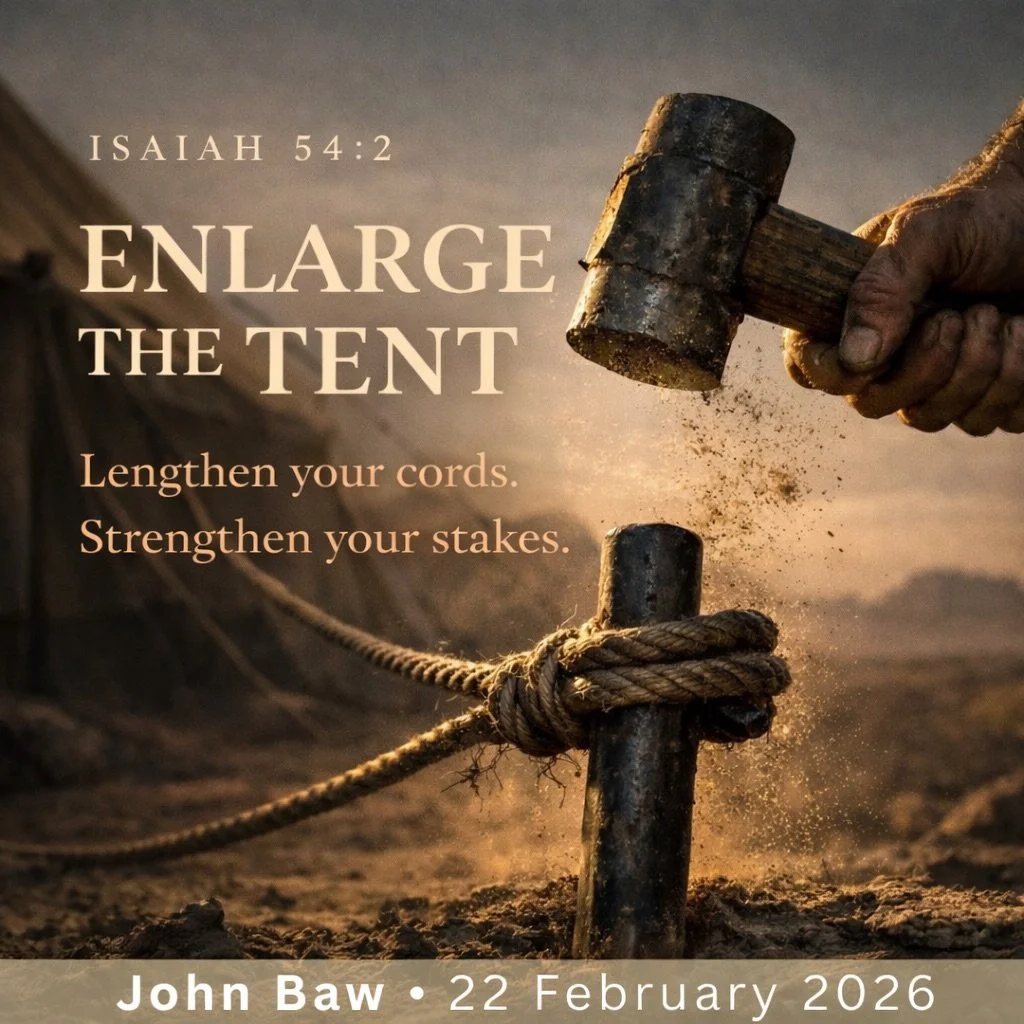
Sermon: Enlarge the Tent

LWC SERMON GUIDE

Enlarge the Tent

Scriptures to read and ponder

  • Main text: Isaiah 54:1–3

  • Additional promise: Isaiah 54:17

  • Other scriptures shared in the sermon:

    • Psalm 127:3

    • Psalm 149:6

    • 2 Corinthians 5:7

    • Hebrews 11:1

Sermon Recap

The waiting room and the silence

  • Many believers find themselves in a prolonged “waiting room season” — not a place, but a stretch of delay.

  • Unanswered prayer can feel like a barren landscape: dry, cracked, silent.

  • The most painful part of barrenness is not the emptiness, but the silence — when you know God can, yet He has not acted in the way you hoped.

God speaks into barren places

  • Throughout Scripture, God repeatedly chooses barren wombs, delayed seasons, and situations that appear dead.

  • When God speaks into barrenness, He does not simply comfort it — He confronts it.

  • His first instruction is not analysis or explanation. It is worship.

A song in the silence (Isaiah 54:1)

  • “Sing, barren woman” is a command that defies logic and emotion.

  • This is not denial or emotional hype. It is faith aligning with what God sees.

  • In the ancient world, barrenness carried economic vulnerability, social shame, and deep grief.

  • Praise is portrayed as spiritual warfare: praise in the mouth and the Word in the hand.

Praise as alignment, not noise

  • Biblical praise is not pretending the desert is already a garden.

  • It is declaring that the desert is not your final destination.

  • “More are the children…” not “more will be…” — God speaks from completion.

  • Faith agrees with what heaven has declared, even when the ground still looks barren.

Enlarge your tent (Isaiah 54:2)

  • The sermon moved from declaration to preparation.

  • “Enlarge… stretch… do not hold back… lengthen… strengthen” — these are verbs of action.

  • In biblical culture, the tent symbolised estate, family, legacy, and influence.

  • The shock is that the tent is empty, yet God commands expansion.

  • We walk by faith, not by sight (2 Corinthians 5:7).

  • Before the outer world expands, the inner world must make space.

  • Stakes must go deeper before curtains go wider.

Spread to the right and to the left (Isaiah 54:3)

  • “You will spread out” is certainty language.

  • Enlargement is not merely personal breakthrough. It is mission and multiplication.

  • This is expansion language, not maintenance language.

  • Believers are not called to mirror cultural anxiety, but to radiate Kingdom peace and influence.

Protection for expanded people (Isaiah 54:17)

  • Enlargement increases visibility, and visibility often attracts opposition.

  • The promise is not that weapons will not form, but that they will not prosper.

  • When God commands expansion, He assumes responsibility for protection.

  • This security is covenant inheritance — the heritage of the servants of the Lord.

  • Because the verdict is secure, we can sing even in the dark night.

Memorable quotes

  • “Some of you have been in a waiting room for years. And I am not talking about a building. I am talking about a season.”

  • “The most painful part of barrenness is not the emptiness. It is the silence.”

  • “When God speaks into a barren place, He does not comfort the barrenness. He confronts it.”

  • “This is not denial. This is faith that sees what God sees.”

  • “Praise is not pretending the desert is a garden. Praise is declaring that the desert is not your final destination.”

  • “First we sing. Then we get to work.”

  • “The tent is empty. And God says: stretch it anyway.”

  • “Before your outer world expands, your inner world must make space.”

  • “If you have enlargement but do not have mission, you will become self-absorbed.”

  • “A bigger tent is a bigger target — but the weapon will not prosper.”


Questions for discussion

  • Where am I currently in a “waiting room season”? What has the silence been shaping in me?

  • Which unanswered prayer have I quietly stopped expecting God to answer?

  • What would it look like for me to “sing” in faith this week before I see any evidence?

  • How do I distinguish between emotional hype and true alignment with God’s declared future?

  • In what area of my life is God asking me to enlarge my tent before I see results?

  • What are the “stakes” in my life that need strengthening (character, discipline, prayer, obedience, boundaries)?

  • Where am I holding back because of fear, disappointment, or past failure?

  • How can my enlargement become mission rather than self-focus?

  • What does “spreading to the right and to the left” look like in my context — family, workplace, friendships, church?

  • When opposition arises, how can I respond from the verdict of Isaiah 54:17 instead of reacting in fear?

  • As a church family, what might enlarging the tent look like for LWC in this season?


Further reading

  • Genesis 18:9–15; 21:1–7 — Sarah and the fulfilment of promise

  • 1 Samuel 1–2 — Hannah’s barrenness and praise

  • Luke 1:5–25; 57–66 — Elizabeth and delayed promise

  • Romans 4:18–21 — Abraham’s faith against hope

  • Habakkuk 3:17–19 — rejoicing before circumstances change

  • 2 Kings 4:1–7 — increase according to capacity

  • Ephesians 3:16–21 — inner strengthening and God’s power

  • Matthew 28:18–20 — mission and multiplication

  • Acts 1:8 — Spirit-empowered expansion

  • Romans 8:31–39 — security under pressure

Recommended resources:

  • John Wimber, Power Evangelism

  • Pete Greig, How to Pray

  • Dallas Willard, The Spirit of the Disciplines

  • Richard Foster, Celebration of Discipline


Prayer points

  • Lord, meet me in the silence and restore hope where it has faded.

  • Holy Spirit, teach me to praise in alignment with heaven before I see evidence on earth.

  • Strengthen my inner life so I can carry the enlargement You are bringing.

  • Show me practical steps to enlarge my tent in obedience and faith.

  • Guard my heart from self-focus and enlarge my compassion for people.

  • As You expand my influence, protect me from fear, accusation, and discouragement.

  • Let no weapon formed against Your purposes in my life or in LWC prosper.

  • Enlarge our church family — deepen our roots, widen our welcome, strengthen our discipleship, and multiply our witness in Gibraltar and beyond.

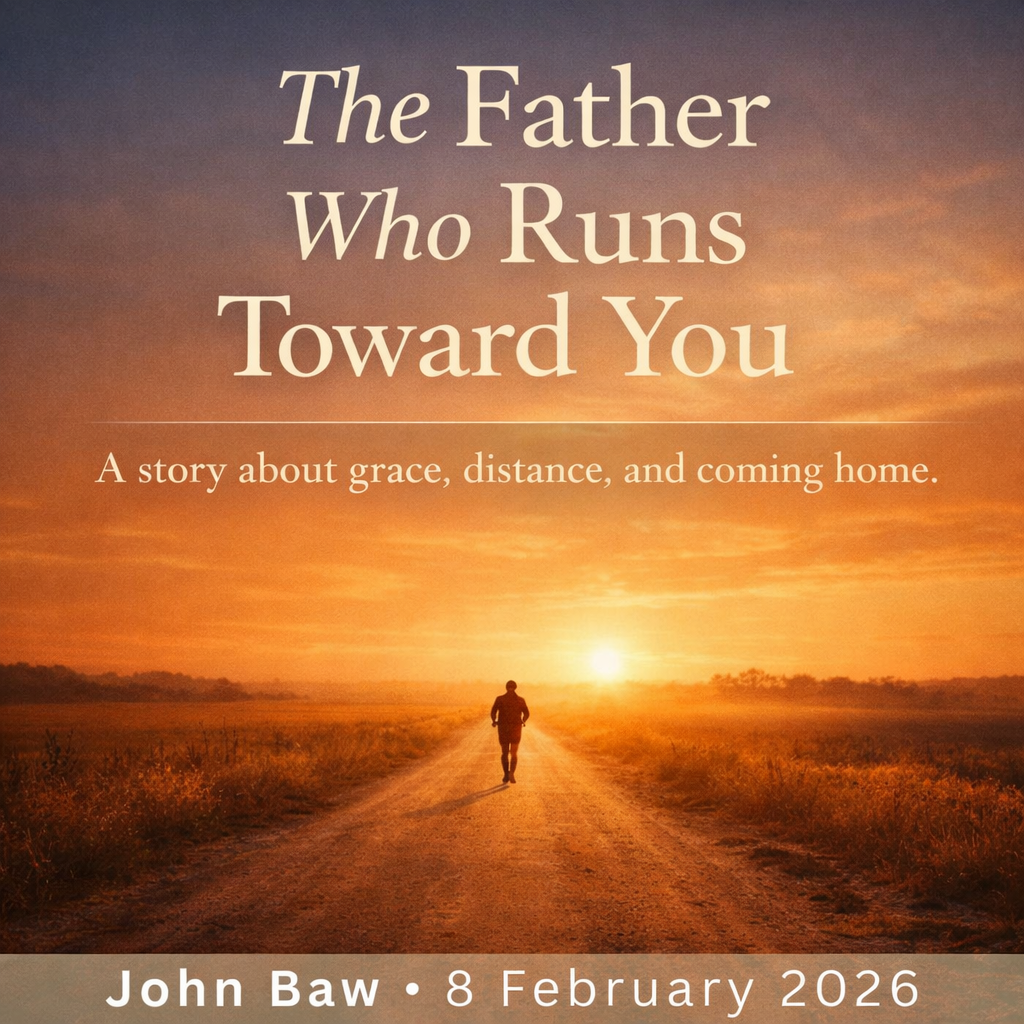
Sermon: The Father who runs toward you

LWC SERMON GUIDE

The Father who runs toward you

A story about grace, distance, and coming home

Scriptures to read and ponder

  • Main teaching text: Luke 15:11–24

  • Other scriptures:

    • Romans 5:8

    • John 3:16

Sermon Recap

1) INTRODUCTION: The missed call

  • The sermon opened with a simple question: Have you ever ignored a call because you were not ready for that conversation?

  • Many people do this with God, not from hatred, but from avoidance, silence, and unreadiness.

  • Distance from God often begins not with rebellion, but with silence.

2) The request that breaks the relationship (Luke 15:11–12)

  • The younger son asks for his share of the estate.

  • In that world, inheritance was typically received after the father’s death, so the request functioned like relational severance, treating the father as “as good as dead.”

  • The human heart often wants the Father’s gifts without the Father’s presence.

  • There is a little of this son in every person, the impulse to live on our own terms while still wanting blessing.

3) The illusion of the distant country (Luke 15:13)

  • The younger son leaves for a distant country and squanders his wealth in wild living.

  • The “gospel of the world” was explained as follows:

    • Everything is a big yes

    • If it feels good, do it

    • If it makes you happy, do it

    • You only live once

  • Indulgence promises freedom but drains life, scattering what God entrusted.

4) Living your own life leads to hunger and dishonour (Luke 15:14–16)

  • After he spends everything, famine hits, and he becomes in need.

  • His “freedom” becomes servitude: he hires himself out, ends up feeding pigs, and longs for their food.

  • The cultural shock for Jesus’ audience: a Jewish man feeding pigs, as a slave, under a Gentile master, a picture of complete degradation and lostness.

  • The spiritual principle: Distance from the Father does not satisfy our appetite, it multiplies our hunger.

5) Coming to our senses (Luke 15:17)

  • The turning point: He “came to his senses.”

  • This was not a performative holiness, it was honest clarity: “This is not working.”

  • Scripture does not simply label people “bad,” it calls them “lost,” and the Gospel is about being found.

6) Repentance is returning, not a performance (Luke 15:18–19)

  • The son rehearses a three-part speech: confession, unworthiness, and a proposal to become a hired servant.

  • The sermon emphasised that Grace is not rational, God’s love is not “reasonable,” and tactics do not purchase return.

  • The essence: “I will go back to my father.”

7) The scandalous heart of God: the Father runs (Luke 15:20)

  • The centre of the sermon and “the centre of the Gospel” is that while the son is still far off, the father sees, feels compassion, runs, embraces, and kisses.

  • God is not reluctant, distant, or cold; He is scanning the horizon, reaching across distance.

  • Even when life makes a person feel invisible, the Gospel declares, “He sees you.”

8) Paul puts words to the running Father (Romans 5:8)

  • Romans 5:8 was used as the explanatory key: God “demonstrates” His love by Christ dying for us while we were still sinners.

  • God does not only declare love, He proves love.

9) Grace interrupts shame (Luke 15:21–22)

  • The father allows confession, but cuts off the hired-servant proposal.

  • The declaration: God is not recruiting servants in this moment, He is restoring sons.

  • The symbols of restored sonship: the best robe, a ring, sandals.

10) From death to life (Luke 15:23–24; John 3:16)

  • The father frames the story as resurrection language: “was dead and is alive again; was lost and is found.”

  • Christianity is not behaviour modification, it is passing from death into life through what He has done.

  • John 3:16 was used to underline the Father’s giving love, with “whoever” meaning no exceptions.

11) Closing exhortation: Be a horizon-scanning church

  • The sermon closed with mission: churches must stop guarding doors and start watching roads, reflecting the Father’s heart for the lost.

  • Final invitation: If you are here, the phone is ringing. There is no need for perfect words. Come home.

    Memorable quotes

    • “Distance from God does not begin with rebellion. It often begins with silence.”

    • “The story Jesus tells is not really a story about a bad son. It is a story about a good father.”

    • “Father, I do not want you, I just want your stuff.”

    • “This is the sermon the world has been preaching to us for years: Everything is a big yes.”

    • “He did not become holy. He became honest.”

    • “Grace is not rational. God’s love is not reasonable.”

    • “God does not only say that He loves us. He proves it.”

    • “God already has servants. God sees you as a son.”

    • “Christianity is not about changing your behaviour. Christianity is about passing from death into life.”

    • Oscar Wilde: “Every saint has a past; and every sinner has a future.”

    Questions for discussion

    1. Where do you most recognise the “missed call” pattern in your spiritual life: avoidance, silence, distraction, shame, independence?

    2. The younger son wanted inheritance without relationship. What are modern ways people try to receive God’s gifts without God Himself?

    3. What is your “distant country”? Not a location, but a pattern: a mindset, appetite, habit, coping mechanism, or identity you run to for relief.

    4. The sermon named the world’s message: “If it feels good, do it.” Where does that message show up most strongly in culture right now, and where does it show up subtly in you?

    5. In Luke 15:14–16, freedom becomes hunger and servitude. What kinds of “servitude” does the distant country create today (approval, addiction, image, debt, lust, workaholism, bitterness)?

    6. What does it look like practically to “come to your senses” this week? Name one honest sentence you need to say to God.

    7. Repentance was framed as returning, not performing. Where do you tend to perform instead of return (promises, bargaining, religious busyness, self-punishment)?

    8. Picture the Father “scanning the horizon.” What does that reveal about God’s posture toward you right now?

    9. Romans 5:8 says God demonstrated love “while we were still sinners.” How does that challenge the idea that you must clean yourself up before you come home?

    10. The father interrupts the hired-servant line. Where do you still relate to God like a servant instead of a son or daughter?

    11. The father says, “dead and alive again.” What areas of your life feel dead, and what would “alive again” look like in real terms?

    12. The sermon ended by challenging the church to reflect the Father’s heart. What would “watching the road” look like for LWC in Gibraltar in the next 30 days?

    Further reading

  • Scripture cross-references (to deepen the same themes):

    • Psalm 139 (God sees, God knows, God pursues)

    • Isaiah 55:6–7 (returning to the Lord; mercy and pardon)

    • Ezekiel 34:11–16 (God as the Shepherd who searches for the lost)

    • Hosea 11:1–9 (the Father’s compassion, love that will not let go)

    • Luke 19:10 (the Son of Man came to seek and save the lost)

    • 2 Corinthians 5:17–21 (new creation; reconciliation; ambassadors)

    • Ephesians 2:1–10 (from dead to alive; saved by grace)

    • 1 John 3:1 (the Father’s love in calling us His children)
    Reading resources (accessible, missionally aligned, and spiritually forming):

    • Tim Keller, The Prodigal God (short, clear, Gospel-centred)

    • Henri Nouwen, The Return of the Prodigal Son (contemplative, heart-forming)

    • Dallas Willard, The Divine Conspiracy (Kingdom life and discipleship formation)

    • N. T. Wright, Simply Christian (evangelistic clarity for seekers)

    • John Mark Comer, Practicing the Way (formation practices for returning and remaining)

    Prayer points

    • For honesty: Lord, bring me to my senses. Give me courage to tell the truth about what is not working.

    • For returning: Father, I return to You, not with performance, but with surrender. I come home.

    • For freedom from the “distant country”: Break the appetites, habits, and agreements that keep me hungry and bound. Replace them with holy desire.

    • For a fresh revelation of the Father’s heart: Let me see You scanning the horizon, moving toward me, not away from me.

    • For healing from shame: Where shame has told me I am unworthy, let grace interrupt that lie and restore sonship.

    • For assurance in the cross: Thank You that You demonstrated love while I was still a sinner. Anchor me in what Christ has done, not what I can prove.

    • For “death to life” breakthrough: Speak life into dead places, dead hope, dead faith, dead joy, dead intimacy. Raise what has been buried.

    • For LWC’s missional posture: Make us a horizon-scanning church. Give us eyes for the lost, compassion for the broken, and courage to run toward people with the love of God.

    • For visitors and seekers: Father, let the phone ringing become a moment of salvation, healing, and coming home. Let people know they are seen.

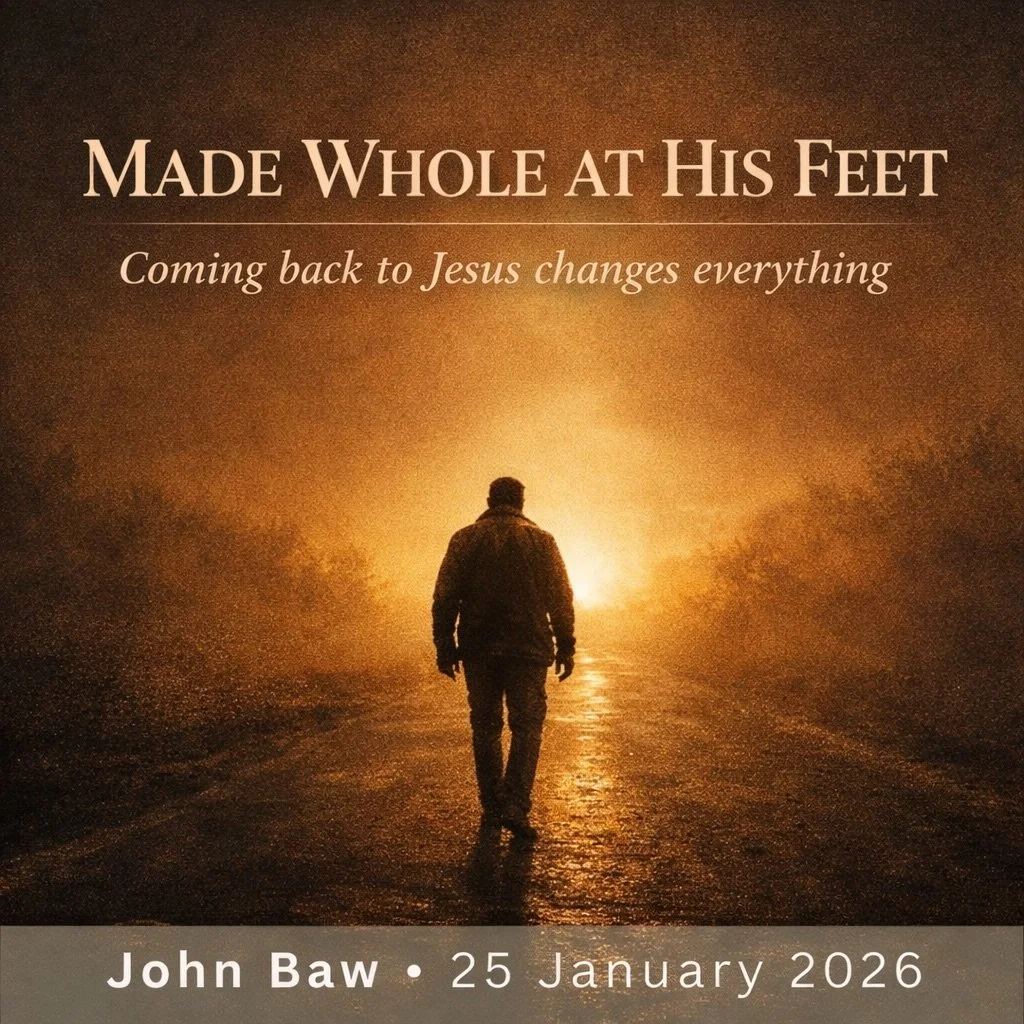
Sermon: Made whole at His feet

LWC SERMON GUIDE

Made whole at His feet

Scriptures to read and ponder

  • Main teaching text: Luke 17:11–19

  • Old Testament background on leprosy and “distance”: Leviticus 13–14

  • Praise that is willing to look foolish: 2 Samuel 6:14–16; 2 Samuel 6:21–22

  • Key theme to hold all week: “Rise and go; your faith has made you well” (SOZO) Luke 17:19

Sermon Recap

Sermon Recap

  • 1) The A&E faith problem: relief without transformation

    • The sermon opened with the picture of a man rushed into A&E: bleeding stopped, crisis stabilised, then sent home.

    • The point: healing is not the same as health; a symptom can stop while brokenness remains.

    • Many people treat Jesus like spiritual A&E: they come for relief, then leave with no follow-up, no return, no new life.

    • The Spirit’s push: do not settle for “functional”; press into “flourishing.”

  • 2) “They stood at a distance”: the condition beneath the condition

    • Ten men with leprosy stand at a distance and cry out for mercy (Luke 17:12–13).

    • Leprosy functioned as more than illness; it was social exclusion and spiritual dislocation (Leviticus 13–14).

    • “Distance” becomes the controlling theme: distance from people, worship, intimacy, joy, work, and hope.

    • Gospel moment: “When he saw them.” Jesus sees what the system excludes.

  • 3) All ten were cleansed: grace makes no exceptions

    • Jesus sends them to the priests, and as they go they are cleansed (Luke 17:14).

    • No discrimination. No special cases. No “not for you.”

    • Grace does not operate by human categories; Jesus is not partial.

  • 4) One returned: the pivot from healing to wholeness

    • Nine are satisfied with the miracle; one is hungry for more.

    • He realises: “If I walk away now, I leave with healing but without wholeness.”

    • Luke notes he was “healed” (iaomai) in the physical sense, but the story moves toward something deeper.

    • Two versions of faith:

      • “Jesus, fix my problem.”

      • “Jesus, fix me.”

  • 5) The path to wholeness: Return, Praise, Surrender

    • Step 1: Always return to Jesus (repentance)

      • He stops, turns around, and walks back.

      • Repentance is not merely remorse; it is a change of direction, a return to the source of life.

      • Repentance is presented as a discipleship rhythm, daily and ongoing.

    • Step 2: Praise (audacious, public, loud)

      • He returns praising God loudly, not quietly.

      • He likely still looks like a leper to everyone watching; stigma is still in the room, but praise wins.

      • David becomes the model: dancing before the Lord, despised by Michal, yet choosing worship over reputation (2 Samuel 6).

      • Praise was framed as a discipleship discipline and a lifestyle, anchored in gathering with God’s people.

    • Step 3: Surrender (at His feet)

      • He throws himself at Jesus’ feet and gives thanks.

      • This is not polite gratitude; it is total life-collapse, a posture that says, “My life is yours.”

      • Luke highlights he is a Samaritan: outsider, “unqualified,” yet he comes closest.

      • Core line: surrender is not a reward for the worthy; it is the response of the grateful.

  • 6) The commission: surrender leads to sending

    • Jesus does not end with comfort; he ends with a command: “Rise and go.”

    • The word “well” is SOZO: saved, healed, restored, delivered, made whole.

    • Big idea: he was healed on the road, but made whole at the feet of Jesus.

    • Outcome: no longer a victim or outsider, but a whole person with a commission.

    Memorable quotes

    • “He has healing, but he does not have health.”

    • “The crisis passed, but the brokenness remained.”

    • “Maybe healing was never the end goal.”

    • “There is a version of faith that only wants relief, and there is a deeper faith that wants restoration.”

    • “There is a faith that says, ‘Jesus, fix my problem,’ and there is a faith that says, ‘Jesus, fix me.’”

    • “Remorse says, ‘I feel bad.’ Repentance says, ‘I am walking back.’”

    • “Surrender is not a reward for the worthy. Surrender is the response of the grateful.”

    • “He was healed on the road. He was made whole at the feet of Jesus.”

    • “Surrender is not the end of the journey, it is the point from which you are sent.”

    Questions for discussion

    • Getting honest about “A&E faith”

      • Where do you most tend to treat Jesus like “spiritual emergency care” rather than Lord of your whole life?

      • What is one pattern where you seek relief quickly but resist long-term formation?

    • Distance and belonging

      • In Luke 17:12, the lepers “stood at a distance.” What does “distance” look like in your own life right now: from God, from people, from church family, from hope?

      • What voices (shame, disappointment, pain, culture) have taught you that closeness is dangerous?

    • The turning point: returning to Jesus

      • What is one concrete “direction” you need to stop walking in, so you can return to Jesus?

      • How does the sermon’s definition of repentance (returning) reshape your understanding of discipleship?

    • Praise as discipleship discipline

      • What most often silences your praise: fear of people, disappointment with God, fatigue, cynicism, or something else?

      • What would it look like for you to choose worship over reputation this week, like David and like the healed man?

    • Surrender at His feet

      • What area of life do you still keep off-limits from Jesus, even though you want his help?

      • The Samaritan is the “outsider” who comes closest. Where do you feel unqualified, and how might that be the very place Jesus is inviting you into surrender?

    • Commissioned wholeness (Rise and go)

      • If surrender is the launchpad for mission, what might Jesus be sending you into this week: home, workplace, a strained relationship, service in the church, witness in the community?

      • What is the difference between being “patched up” and being “made whole” in your everyday life?

    Further reading

    • Scripture:

      • Psalm 34

      • Psalm 103

      • Isaiah 57:15

      • Matthew 11:28–30

      • Romans 12:1–2

      • Luke 5:12–16

      • Luke 7:36–50

    • Reading resources:

      • A short study on repentance as “returning” (metanoia) and daily discipleship rhythms

      • A simple guide to building a weekly “praise plan”: Sunday gathering, midweek worship, gratitude practice, and testimony sharing

      • A reflective resource on surrender and lordship: inviting Jesus into every room of life

    Prayer points

    • Return (repentance):

      • Jesus, expose every direction I am walking that leads away from you. Give me grace to turn back quickly and consistently.

      • Father, replace shame-driven distance with Spirit-led closeness. Teach me to come home again.

    • Praise (audacious worship):

      • Holy Spirit, put praise back in my mouth. Break fear of people and restore first-love worship.

      • Lord, make my life an offering of worship: in church gatherings, in private devotion, and in ordinary weekdays.

    • Surrender (at His feet):

      • Jesus, I throw myself at your feet. I release control, self-protection, and the need to manage outcomes.

      • Father, I bring you the hidden places: pain, trauma, habits, bitterness, and fear. Make me whole.

    • Wholeness (SOZO):

      • Jesus, I ask for more than symptom relief. Save, restore, deliver, and make me whole in spirit, soul, and body.

    • Commission (Rise and go):

      • Lord, as you send me, give me courage, clarity, and compassion. Let my restored life become a witness of your Kingdom in Gibraltar.

      • Jesus, show me one practical act of obedience this week that proves I am not only healed, but also changed.

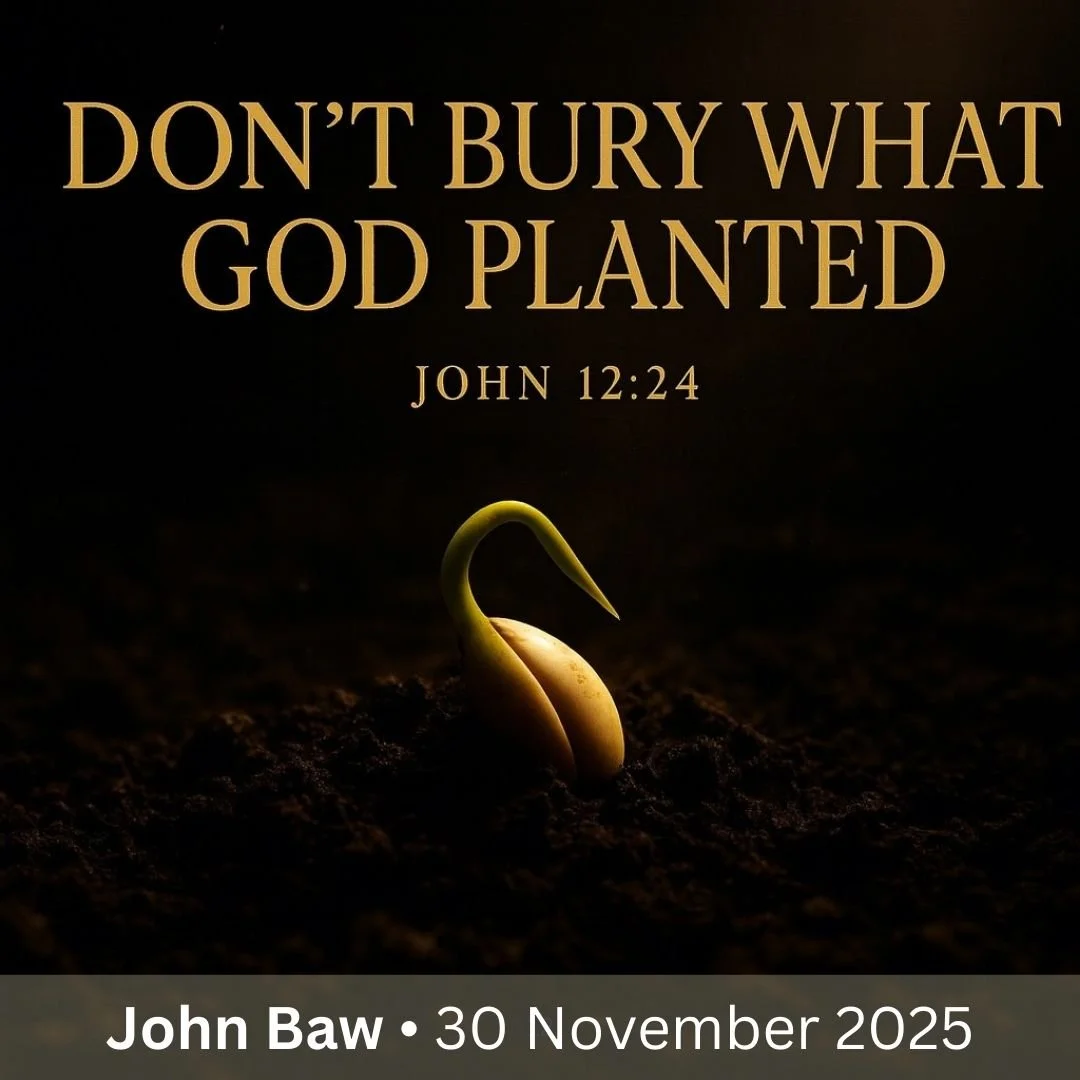
Sermon: Don't bury what God planted

LWC SERMON GUIDE

Don’t Bury What God Planted

Scriptures to read and ponder

main Text

  • John 12:24“Unless a grain of wheat falls into the earth and dies, it remains alone; but if it dies, it bears much fruit.”


Supporting Scriptures from the Sermon

  • 1 Corinthians 15:36“What you sow does not come to life unless it dies.”

  • Genesis 37:17–20, 23–24 – Joseph betrayed by his brothers and thrown into the pit.

  • Genesis 39:20–23 – Joseph in the royal prison, yet the Lord is with him and gives him favour.

  • Genesis 50:20“You meant evil against me, but God meant it for good…”

  • Psalm 105:17–19 – God sent Joseph ahead; the word of the Lord “proved him true”.

  • 2 Corinthians 4:10–12“We always carry around in our body the death of Jesus, so that the life of Jesus may also be revealed…”

  • Psalm 126:5“Those who sow with tears will reap with songs of joy.”

Sermon Recap

1. The Seed’s Journey: Darkness, Pressure, Breaking

  • A seed never starts its journey in the sunlight; it starts in the dark:

    • A darkness where you can’t see your hand in front of your face.

    • A darkness where you lose direction and question what you heard from God.

  • The seed is:

    • Pressed down into the earth.

    • Buried under weight it never asked for.

    • Surrounded by layers of soil – pressure on top of pressure.

    • In an environment that screams: “Stay down. Stay hidden. Stay silent.”

  • The environment is:

    • Restrictive, cramped, suffocating.

    • Hemmed in on every side – no space, no air, no room to stretch.

  • Under that pressure:

    • The shell begins to break.

    • Everything in the natural screams, “This is death. This is the end. This is where my story finishes.”

  • If the seed had feelings, it would conclude:

    • Isolation = forgotten.

    • Darkness = God changed His mind.

    • Pressure = the promise has expired.

  • But what the seed calls death, God calls birth:

    • While the seed thinks it’s being buried, it’s actually being positioned.

    • While it thinks it’s dying, it’s actually being unlocked.

    • In the darkness, life is being awakened.

    • Under pressure, potential is emerging.

    • In restriction, roots are forming.

    • In the breaking, wholeness is being released.

  • Key idea:
    The very conditions that feel like a burial are the exact conditions God uses for transformation.

2. When Your Calling Feels Buried

  • Context of John 12:

    • Some Greeks (outsiders, seekers) come wanting to see Jesus.

    • At that key moment, Jesus speaks not of signs and wonders but of His hour and of a grain of wheat falling into the ground and dying.

  • John 12:24 reveals the pattern of the Kingdom:

    • Not glory → then suffering, but suffering → then glory.

    • Not visibility → then impact, but hiddenness → then multiplication.

  • Phrase-by-phrase breakdown:

    • “Falls to the ground” = surrender.

    • “Dies” = letting go of control.

    • “Remains only a single seed” = what happens when we hold our lives too tightly.

    • “Produces many seeds” = multiplication, increase, fruitfulness.

  • Jesus’ promise:

    • “If you will surrender it, I will multiply it.”

    • What looks like loss becomes the doorway to abundance.

  • Many of us live here:

    • Not on the mountaintop or in obvious favour.

    • But underground: in the dark, pressed, restricted, breathing recycled air.

    • Life feels more like a coffin than a launchpad.

  • 1 Corinthians 15:36:

    • “What you sow does not come to life unless it dies.”

    • Resurrection power is only released in surrendered places.

  • Reframing the season:

    • Darkness ≠ death.

    • Burial ≠ the end.

    • Hidden ≠ forgotten.

3. Joseph: Pits, Prisons, and Preparation

  • Joseph’s context:

    • One of twelve brothers, in a complicated and messy family.

    • Marked by jealousy, favouritism, competition, wounds.

    • Deeply loved by his father; given a special robe that triggers resentment.

  • Joseph’s God-given dreams:

    • Dreams of influence and leadership.

    • Dreams hinting at a future far beyond his current reality.

    • Instead of celebrating, his family feels threatened: “Here comes that dreamer!”

  • The pit (Genesis 37:17–20, 23–24):

    • The brothers plot to kill him.

    • They strip him of his robe and throw him into an empty cistern.

    • The dreamer is now in the dark – buried in a hole in the ground.

  • The prison (Genesis 39:20–23):

    • Sold into slavery in Egypt.

    • Serves faithfully.

    • Falsely accused and thrown into the royal prison.

    • Loses job, reputation, freedom – despite doing nothing wrong.

    • Again, he is buried in a place he did not choose.

  • God’s interpretation (Psalm 105:17–19):

    • God sent a man before them – Joseph.

    • Shackles, irons, and hardship lasted until the word of the Lord proved him true.

    • God wasn’t punishing Joseph; God was preparing him.

    • The pit was preparation.
      The prison was his training ground.

  • Formation in the hidden place:

    • In prison, Joseph learns administration, timing, wisdom, discernment.

    • These were the exact competencies needed for his assignment as Prime Minister.

  • The turnaround (Genesis 50:20):

    • “You meant evil against me, but God meant it for good…”

    • What tried to bury Joseph is what God used to build Joseph.

  • Outcome:

    • One conversation with Pharaoh moves him from prisoner to Prime Minister.

    • The ground that held him becomes the ground that released him.

  • Application:

    • Some of us feel buried, locked into situations we did not choose.

    • Joseph’s story teaches:
      God plants what He intends to multiply.

4. Jesus: The Seed Who Chose the Soil

  • John 12 is not about gardening tips; it is revelation:

    • Jesus is not ultimately talking about wheat but about Himself.

  • Jesus as the Seed:

    • The Seed who surrendered to the soil.

    • The Life who chose the tomb.

    • The One who entered the ground not to be buried, but to be planted for the multiplication of sons and daughters.

    • He didn’t “get buried”; He planted Himself.

  • Implication:

    • When Jesus enters the soil, resurrection becomes inevitable.

    • Because Jesus went into the ground first:

      • Your pit is not wasted.

      • Your prison is not wasted.

      • Your pressure is not wasted.

    • He set the pattern and sanctified the soil you are standing in.

5. Identity: You Are a Seed of the Kingdom

  • 2 Corinthians 4:10–12:

    • We carry the death of Jesus so that the life of Jesus may be revealed.

    • The breaking reveals His life.

    • The pressure reveals His strength.

    • The hidden places reveal His glory.

  • This is not just Joseph’s pattern – it is the pattern for every disciple.

  • Kingdom identity statements:

    • You are a seed of the Kingdom, designed for multiplication.

    • There is fruit inside you that has not yet seen the light of day.

    • You are not buried potential; you are planted purpose.

    • You are not a forgotten field; you are sacred soil.

    • You are not a discarded seed; you are a chosen promise.

  • The world:

    • Defines you by what has happened to you.

  • Jesus:

    • Defines you by what He has planted in you.

6. The World Hides; The Kingdom Plants

  • Repeated emphasis from John 12:24:

    • The call is to bear much fruit.

  • Cultural tension:

    • We live in a visibility-obsessed culture:

      • Everyone wants platform, spotlight, prominence.

  • Kingdom reality:

    • The Kingdom often begins:

      • In secret.

      • Under the ground where no one sees.

      • In surrender, obscurity, hiddenness.

    • There are seasons of:

      • Darkness.

      • Pressure.

      • Layers of “soil” pressing in.

    • These are the conditions that form diamonds.

7. What Have You Buried That God Planted?

  • Psalm 126:5:

    • “Those who sow with tears will reap with songs of joy.”

    • Your tears were the water.

    • Your prayers were the planting.

    • Your breaking was the beginning.

  • Key question:

    • What have you buried that God planted?

  • Types of seeds in the room:

    • Burnt-out seeds:

      • Dreams almost dead under exhaustion and heaviness.

      • Buried because life feels too heavy.

      • God has planted them to grow beyond your own strength.

    • Shamed seeds:

      • Gifts locked away because you don’t feel worthy.

      • Buried because your past speaks louder than your promise.

      • God planted them because grace writes a brighter future than sin can describe a past.

    • Fearful seeds:

      • Callings hidden because the price feels too high.

      • Buried because risk terrifies you.

      • God planted them because courage grows in dark places.

  • Heaven’s perspective:

    • What we call dead, God calls planted.

    • What we call the end, God calls the beginning.

    • What we call a prison, God calls a birthing place.

  • Prophetic sense:

    • Some are about to sprout in the very places where they thought they were finished.

8. Conclusion: Stop Burying What God Has Planted

  • This is not the moment to:

    • Shrink back.

    • Stay hidden.

    • Bury your gift to fit in with the culture.

  • This is the moment to:

    • Let the pressure break the outer shell.

    • Allow the life within you to burst through the soil.

    • Stop negotiating with the dirt and getting comfortable underground.

  • Seeds are not designed to stay in the dark;
    they are designed to crack open and let new life emerge.

  • John 12:24 re-affirmed:

    • If the grain dies, it will bear much fruit – that is:

      • Your calling.

      • Your season of growth.

      • Our season as a church.

  • Prophetic declaration over LWC:

    • A season of sprouting.

    • A season of growth.

    • A season of fruit.

    • A season where hidden things burst into the open by God’s Spirit.

  • Heaven’s “board-level” directive:

    • Stop burying what God has planted.

    • Stop hiding what God has anointed.

    • Stop silencing what God has ignited.

    • The Holy Spirit is moving in the soil of our hearts.

    • The ground that held you back is about to release you.

    Memorable quotes

    • “What the seed calls death, God calls birth.”

    • “You are not being buried; you are being planted.”

    • “God plants what He intends to multiply.”

    • “Your pit is not wasted. Your prison is not wasted. Your pressure is not wasted.”

    • “You are not buried potential; you are planted purpose.”

    • “The world defines you by what has happened to you; Jesus defines you by what He has planted in you.”

    • “What we call dead, God calls planted. What we call the end, God calls the beginning. What we call a prison, God calls a birthing place.”

    • “Seeds are not designed to stay in the dark; they are designed to crack open and allow new life to emerge.”

    • “Your tears were the water; your prayers were the planting; your breaking was the beginning.”

    Questions for discussion

    Heart-level reflection

    • Where do you currently feel underground – in the dark, under pressure, restricted or suffocated?

    • Have you ever misread a season as a burial when, in hindsight, it was actually a planting? What changed your perspective?

    • Which type of seed do you most identify with right now:

      • Burnt-out seed (exhaustion, heaviness)?

      • Shamed seed (past failures, unworthiness)?

      • Fearful seed (afraid of the cost or risk)?

    • What have you quietly buried – a gift, calling, dream, assignment – that may actually be something God planted?

    Scripture engagement

    • Read John 12:24 slowly.

      • What word or phrase stands out most to you (falls, dies, remains alone, bears much fruit)? Why?

    • How does 1 Corinthians 15:36 challenge our natural response to loss, disappointment, or delay?

    • Looking at Joseph’s story (Genesis 37, 39, 50 and Psalm 105:17–19), what stages of his life feel most similar to your own story or season?

    • How does 2 Corinthians 4:10–12 help you reinterpret pressure, breaking, and hiddenness in your own life?

    Identity and calling

    • Which of the identity statements do you find hardest to believe:
      “I am sacred soil,” “I am planted purpose,” “I am a chosen promise” – and why?

    • How might your decisions change this week if you really believed:
      “I am a seed of the Kingdom designed for multiplication”?

    • Where are you tempted to chase visibility instead of embracing God’s work in hiddenness?

    • In which area of your life do you sense the Holy Spirit saying, “Stop burying what I have planted”?

    Action and response

    • What is one specific step you can take this week to “unbury” a God-given seed (e.g. a conversation, a discipline, a small act of obedience)?

    • Who in your world needs encouragement because their season feels like a burial? How can you practically speak life and hope into them?

    • As a church family, what might it look like for LWC to live as a planted people, not a hidden people, in Gibraltar?

    Further reading

    Scriptures reinforcing the message

    • John 12:20–28 – Wider context around the grain of wheat and Jesus’ “hour”.

    • Romans 8:18–30 – Present sufferings and future glory; God working all things for good.

    • James 1:2–4 – Trials producing perseverance and maturity.

    • John 15:1–8 – Abiding in the Vine and bearing much fruit.

    • Galatians 6:7–9 – Sowing, reaping, and not growing weary in doing good.

    • Isaiah 61:1–3 – Beauty for ashes, joy for mourning, praise instead of despair.

    • 1 Peter 5:6–10 – Humbling ourselves under God’s mighty hand; after we have suffered a little while, He restores and establishes us.

    • Philippians 1:6 – He who began a good work in you will carry it on to completion.

    • Hebrews 12:1–2 – Running with perseverance, fixing our eyes on Jesus, who endured the cross for the joy set before Him.

    Prayer points

    1. Surrender and re-framing

    • Pray for grace to surrender the “seed” of your life, calling, and dreams into God’s hands:

      • “Lord, where I see burial, teach me to see planting.”

    • Ask the Holy Spirit to reframe dark, pressured, or hidden seasons:

      • “Father, show me where You are working in the soil I stand in.”

    2. Healing for burnt-out, shamed, and fearful seeds

    • Burnt-out seeds:

      • Pray for those exhausted and overwhelmed, who feel they have nothing left to give.

      • Ask God to breathe fresh strength and to water what feels dry and dead.

    • Shamed seeds:

      • Pray for freedom from condemnation and the lies of the past.

      • Ask God to speak identity louder than history: “Grace writes a brighter future.”

    • Fearful seeds:

      • Pray against paralyzing fear of risk, cost, and failure.

      • Ask for courage to obey in the dark, trusting God with the outcomes.

    3. Formation in the “pit and prison” seasons

    • Thank God that pits and prisons are training grounds, not waste grounds.

    • Pray:

      • “Lord, form in me the character, wisdom, and competencies I will need for my future assignment.”

    • Ask God to help you co-operate with His process rather than resent it.

    4. Identity as seeds of the Kingdom

    • Declare over yourself and the church:

      • “We are seeds of the Kingdom, designed for multiplication.”

      • “We are not buried potential – we are planted purpose.”

    • Pray for a deep internal shift:

      • That LWC would live as sacred soil in Gibraltar – carrying heaven’s life into every sphere (family, workplace, city).

    5. Fruitfulness and corporate calling for LWC

    • Pray that this would be a season of sprouting for LWC:

      • Hidden ministries, gifts, and callings coming into the light.

      • New fruit in evangelism, discipleship, generosity, and compassion.

    • Ask the Holy Spirit to:

      • Uncover gifts that have been buried in the church.

      • Call people into their next step of obedience and service.

      • Use LWC as a planted community bringing life to Gibraltar.

    6. Boldness to stop burying what God has planted

    • Pray for holy boldness:

      • To stop hiding what God has anointed.

      • To stop silencing what God has ignited.

    • Pray a commissioning-style prayer:

      • “Holy Spirit, move the soil in our hearts. Unearth what You have planted. Let the ground that held us now release us into Your purposes, in Jesus’ Name.”

Sermon: Born of the Voice

LWC SERMON GUIDE

Born of the Voice

Scriptures to read and ponder

Primary Text

  • Judges 6:1–12 — Israel’s oppression, Gideon in the winepress, and Heaven’s declaration: “The LORD is with you, mighty warrior.”

Supporting Scriptures from the Sermon

  • Romans 12:2 — Transformation through renewing the mind.

  • Judges 6:25–26 — Tearing down the altars of Baal and building a proper altar to the LORD.

  • Judges 6:34“The Spirit of the LORD clothed Gideon.”

  • John 4:23–24 — Worship in Spirit and in truth.

  • Psalm 139:14 — You are fearfully and wonderfully made.

  • John 15:16 — “You did not choose Me, but I chose you…”

  • Ephesians 2:10 — You are His workmanship, His masterpiece.

Sermon Recap

I. The Darkness and the Tension

  • Israel intentionally abandoned the ways of God.

  • God’s judgment was not punitive rage but permissive withdrawal — He honoured their choices.

  • Life outside God’s covering produced vulnerability, repeated loss, and cycles of planting without harvest.

  • Israel hid in caves, clefts, and strongholds — living beneath their calling and inheritance.

II. Gideon in the Winepress

  • Gideon should have been threshing wheat on an open threshing floor — where the wind carries the chaff.

  • Instead he threshed in a winepress, a cramped pit in the ground.

  • He was functioning, but not flourishing.

  • This is the biblical picture of oppression — surviving below your God-given identity.

III. God’s Initiative Breaks In

  • Into the cramped space…

  • Into the fear…

  • Into the private anxiety…
    Heaven breaks in with a WORD:
    “The LORD is with you, mighty warrior.”

Key points:

  • God speaks identity before performance.

  • God does not describe you — He defines you.

  • The winepress becomes a womb when Heaven speaks.

  • God calls you by where He is taking you, not by what you are currently living.

IV. Identity Spoken Before Performance

  • In the Kingdom, identity precedes character, calling, and impact.

  • God declared “Mighty Warrior” before Gideon had fought a single battle.

  • Heaven sees fullness, not fragments.

  • Examples of God’s identity declarations over us:

    • Fearfully and wonderfully made

    • Chosen, appointed to bear fruit

    • God’s workmanship — His masterpiece

V. The Call to Rise: Character Formation

  • Identity is the starting point — but alignment is the process.

  • Gideon had to tear down the altar of Baal in his father’s house.

  • Some altars in our inner world must come down:

    • Misplaced trust

    • Wrong beliefs

    • Old patterns

    • False voices

  • Worship “in Spirit and truth” requires the inner world to come into alignment with the voice of God.

  • You cannot worship in Spirit while thinking like the winepress.

VI. From Calling to Impact

  • After identity and alignment came empowerment:

    • “The Spirit of the LORD clothed Gideon.”

  • What began in a pit became a national deliverance.

  • When identity, alignment, and obedience converge — transformation flows outward.

VII. Prophetic Summons

  • God is calling His people out of hiding.

  • Out of the winepress.

  • Out of the old voices.

  • Into identity, freedom, worship, and Kingdom purpose.

  • “You are not born of fear, or failure, or brokenness.
    You are born of the Voice.”

Memorable Quotes

  • “The most dangerous thing in your life is not your past — it’s the wrong voice.”

  • “You don’t rise to your potential — you rise to the voice you listen to.”

  • “When God declares something, He doesn’t describe you — He defines you.”

  • “The winepress that hid you becomes the womb that births you.”

  • “God declares your DNA before He examines your résumé.”

  • “You cannot worship in Spirit while thinking like the winepress.”

  • “The Spirit of the LORD clothed Gideon — Heaven wrapped him.”

Questions for Discussion

Identity & Inner World

  1. What are the “voices behind the curtain” that have shaped your identity?

  2. Which false narratives still influence your decisions, confidence, or sense of worth?

  3. What does it mean to you that God defines you before you perform?

Winepress Living

  1. Where in your life do you feel like you’re surviving but not thriving?

  2. How has fear, pressure, or circumstances pushed you into a “winepress”?

Character Formation

  1. What “altars of Baal” (old patterns, misplaced trust, destructive habits) need to come down?

  2. What practical steps can you take this week to align your inner world with Scripture?

Worship in Spirit and Truth

  1. How does renewing the mind deepen worship?

  2. What lies or old voices still hinder you from worshipping freely and fully?

Calling and Impact

  1. Where do you sense the Holy Spirit calling you to rise and lead?

  2. What could it look like for the Spirit of the Lord to “clothe you” in this season?

Further Reading

Scriptures reinforcing today’s message

  • Isaiah 43:1–4 — God calls you by name.

  • 1 Peter 2:9 — A royal priesthood, a holy nation, a chosen people.

  • 2 Corinthians 10:3–5 — Taking thoughts captive.

  • Ephesians 1:3–14 — Identity in Christ.

  • Joshua 1:9 — Strength and courage in calling.

  • Romans 8:1–17 — Life in the Spirit and adoption as children of God.


Prayer Points

  1. Identity Revelation

    • Pray that every member of LWC hears Heaven’s declaration:
      “The LORD is with you, mighty warrior.”

  2. Renewing the Mind

    • Pray for liberation from old voices, lies, and destructive self-talk.

    • Pray for clarity, truth, and alignment with God’s Word.

  3. Breaking Old Altars

    • Pray for courage to tear down patterns, habits, and beliefs that oppose God.

    • Pray for a rebuilding of “proper altars” — devotion, surrender, worship.

  4. Worship in Spirit and Truth

    • Pray that our worship flows from renewed minds and aligned hearts.

    • Pray for fresh intimacy with the Holy Spirit.

  5. Holy Spirit Empowerment

    • Pray for the Spirit of the LORD to “clothe” the church.

    • Pray for courage, leadership, and boldness to step out of the winepress.

Sermon: Dawn in a Darkened Age

LWC SERMON GUIDE

Dawn in a Darkened Age

  • Scriptures to read and ponder

    • Main text

      • Isaiah 60:1–3
        “Arise, shine, for your light has come, and the glory of the Lord rises upon you.
        See, darkness covers the earth and thick darkness is over the peoples,
        but the Lord rises upon you and his glory appears over you.
        Nations will come to your light, and kings to the brightness of your dawn.”

    • Other key scriptures from the sermon

      • Genesis 1:2–3 – God speaks light into chaos and darkness

      • Romans 13:11–14 – Wake up from slumber; put on the armour of light

      • Deuteronomy 18:15 – “The Lord your God will raise up (qûm) for you a prophet…”

      • Matthew 5:14–16 – You are the light of the world; do not hide your light

  • Sermon Recap

    1. Introduction – When the lights go out

    • Recent Gibraltar power cuts as a picture of our age:

      • One moment: normal life

      • Next moment: everything shuts down – shops, lifts, screens, movement

    • In that sudden darkness:

      • A tiny candle became the most powerful thing in the room

      • The candle did not “fix” the power grid

      • But it pushed back the darkness right where it stood

      • A single flame “humiliating” a whole room of shadows

    • Big idea:

      • Our moment in history feels like a power cut in the soul

      • God is calling His people to be that “candle” in the room

    2. The atmosphere of this age

    • Rising mental and emotional pressure:

      • Mental health conditions soaring

      • Young adults drowning in anxiety

      • We are the most prosperous and the most medicated generation in history

    • These are not just “statistics”:

      • They are sons and daughters

      • They are the people on your street, in your office, in your row at church

    • The darkness is not just “out there” in society:

      • It walked into the room with us

      • Some marriages are running on fumes behind a smile

      • Some parents and grandparents are exhausted beyond words

      • Some are battling anxiety they do not even have language for

    • Many woke up today thinking:

      • “God, please say something. Please do something. I am at the end of myself.”

    • Survival mode has become the new normal:

      • Functioning but not flourishing

      • Numb, disoriented, disconnected

    3. Darkness and thick darkness

    • Isaiah 60:2 – “Darkness covers the earth and thick darkness the peoples”

      • Isaiah is not being dramatic; he is being honest

      • He gives language to what our souls already know

    • “See / Behold”:

      • The prophet calls us to pay attention

      • He wants us to see and name what is happening in our age

    • What is “darkness” in Scripture?

      • Not just “absence of light”

      • It is the presence of something hostile – an environment contrary to God’s ways

      • Four dimensions:

        • Moral confusion

          • Right and wrong inverted

          • Good called evil; evil called good

          • A culture that has lost its moral compass

        • Spiritual blindness

          • Cannot perceive God or value truth

          • Dullness and leanness of soul

        • Emotional collapse & exhaustion

          • Fear, anxiety, despair as the norm

          • Burnout as a lifestyle

        • Fragmentation

          • Families unravelling

          • Communities divided

          • Nations polarised

      • “Darkness is the operating system of a fallen world.”

    • “Covers” – an active, expanding force:

      • Darkness is on the move

      • It spreads from mind → home → classroom → office → culture

      • It escalates from darkness to thick darkness

    • This is not an ancient museum text:

      • It is a present-day doctor’s diagnosis

      • A world more connected than ever, yet more confused than ever:

        • Information exploding; wisdom evaporating

        • Endless voices; very little truth

        • Full schedules; empty souls

        • Houses full of technology; homes empty of peace

    • Result:

      • Chaos in the mind

      • Chaos in the home

      • Chaos in the streets

      • Chaos in the culture

    4. “Arise, shine, for your light has come”

    • God’s pattern:

      • “God never exposes what He does not intend to heal.”

      • He does not name darkness so we can sit in despair

      • He names darkness because He is about to speak a word into it

    • Creation pattern (Genesis 1:2–3):

      • The earth: “a soup of nothingness… inky blackness”

      • Chaos. Emptiness. Deep darkness.

      • Into that, God speaks: “Let there be light.”

      • He does not just diagnose; He creates a new reality with His Word

    • Isaiah 60:1 – “Arise, shine, for your light has come”
      • Heaven issues a command, not a suggestion

      • God stands over His people and says: “Enough lying low. Get on your feet.”

    5. Three dimensions of “Arise” (qûm)

    • a) Arise = Wake up

      • Romans 13:11–14 – “The hour has already come for you to wake up from your slumber”

      • Many are “asleep” not physically, but spiritually:

        • Asleep to calling

        • Asleep to mission

        • Asleep to the truth God is telling about them

      • The Spirit asks: “Have you checked the time?”

        • The night is nearly over; the day is almost here

        • Time to put aside deeds of darkness and put on the armour of light

    • b) Arise = Step into your office

      • Qûm used as commissioning language in the Old Testament

      • Deuteronomy 18:15 – God will “raise up” (qûm) a prophet

      • God is not just waking someone up; He is:

        • Appointing

        • Installing

        • Authorising

      • He raises deliverers, judges, prophets, leaders

      • Word for the church:

        • Stop shrinking back from what God has given you

        • Stop apologising for the mantle on your life

        • Stop negotiating with the call

        • Step into your office; stand in your assignment

    • c) Arise = Advance

      • Military command – shift from observation to engagement

      • “Arise, let us go up…”; “Arise, for the Lord has given them into your hand…”

      • It is the trigger between:

        • Watching and fighting

        • Waiting and moving

      • Meaning:

        • Stop merely studying the darkness

        • Challenge it

        • Push back against it

        • Take ground

      • The original hearers did not hear a polite suggestion; they heard a battle order

    6. Shine – Make God’s presence visible

    • “Shine” is not self-generated light:

      • The brilliance is not ours; it is His

      • We are not the source; we are the surface

    • Matthew 5:14–15 – “You are the light of the world”

      • A city on a hill cannot be hidden

      • Lamps are not lit to be put under a bowl

      • They are placed on a stand to give light to everyone in the house

    • The real issue for many believers:

      • They are not lacking light; they are hiding the light they already have

      • We hide it under:

        • Fear

        • Shame

        • Comparison

        • People-pleasing

        • Trauma and past hurts

      • The Spirit’s word: “Take the basket off.”

    • “Your light has come” – past tense

      • We do not arise and shine because something needs to happen

      • We arise and shine because something already happened:

        • The Cross happened

        • The Resurrection happened

        • Pentecost happened

      • We are not waiting for permission; we already carry the outcome

    • “The glory of the Lord rises upon you”

      • Glory: splendour, weight, honour, reputation

      • God’s excellence rests on us and radiates from us

    7. ReframING identity – From survivors of the dark to bearers of the light

    • Isaiah 60:1–3 reframes who we are:

      • You may have passed through darkness, but you are not darkness

      • You may have felt fear, but you are not that fear

      • You may carry exhaustion, but God says there is a power source you do not yet know

    • New identity markers:

      • You are a dawn maker

      • You are a glory carrier

      • You are a light bearer in an age of chaos

    • The glory on you is not a private blessing:

      • God chose you

      • God called you

      • God saved you

      • God commissioned and sent you

    • Strategic mandate:

      • You are not saved to be frozen

      • You are not meant to leave the world as you found it

      • You are sons and daughters of the Most High God:

        • Ordained to rise

        • Ordained to shine

        • Ordained to dispel darkness wherever you are

    • Missional promise:

      • “Nations will come to your light, and kings to the brightness of your dawn”

      • People are drawn not to our perfection, but to the brightness of God’s glory in us

    8. Conclusion – Time to rise and shine

    • It is time:

      • To wake up from comfort

      • To step out of complacency

      • To rise in holiness

      • To shine with courage

      • To stand in authority

      • To walk into dark places carrying Kingdom light

    • Call to action:

      • Arise and shine – your light has already come

      • Carry that dawn into:

        • Your family

        • Your workplace

        • Your city

        • Your nation

        • Your world

  • Memorable quotes

    • “A single flame humiliating an entire room of shadows.”

    • “God never exposes what He does not intend to heal.”

    • “Darkness is not just the absence of light; it is the operating system of a fallen world.”

    • “We are watching a world more connected than ever, yet lonliner than ever.”

    • “God does not name the darkness so you can sink into despair; He names it because He is about to speak a Word into it.”

    • “Arise is not a suggestion from Heaven; it is an operational command.”

    • “Stop negotiating with the call. Step into your office.”

    • “You are not the source of the light; you are the surface on which His glory shines.”

    • “Many believers are not short of light; they are hiding the light they already have.”

    • “We do not arise and shine because something needs to happen; we arise and shine because something has already happened – the Cross, the Resurrection, Pentecost.”

    • “God did not save you to freeze you.”

  • Questions for discussion

    Engaging the text

    • What words or phrases in Isaiah 60:1–3 stood out to you most strongly today, and why?

    • How does seeing “your light has come” (past tense) change the way you read this passage?

    • Which of the three dimensions of “Arise” (wake up, step into your office, advance) feels most relevant to your current season?

    Naming the darkness honestly

    • Where do you see “thick darkness” in our culture – moral confusion, spiritual blindness, emotional exhaustion, fragmentation?

    • What does “darkness covers the earth” look like on the ground in Gibraltar – in schools, workplaces, families, online spaces?

    • Are there areas of your life where you have normalised survival mode and stopped expecting change?

    From diagnosis to calling

    • How does the statement “God never exposes what He does not intend to heal” challenge the way you see your own pain, your family’s struggles, or our society?

    • In what ways might you have been “asleep” to your calling, potential, or mission in Christ? What would “waking up” look like in practical terms this week?

    • Where might God be asking you to stop “studying the darkness” and start pushing back – at home, at work, at school, in friendships?

    Stepping into your office

    • What “office” or role has God already laid on your shoulders (at home, in church, in your workplace, among your friends)?

    • Are you currently shrinking back, apologising, or negotiating with that call? What is one concrete step you can take to stand in your assignment?

    • As a church family, what would it look like for LWC to live as a community that has “arisen” – awake, commissioned, and advancing?

    Shining in the dark

    • What is the “basket” that most often hides your light – fear, shame, comparison, people-pleasing, past trauma?

    • What might it look like, very practically, to “take the basket off” this week?

    • Who in your world is currently walking in darkness who might be drawn to “the brightness of your dawn” if you began to shine more openly?

    Responding together

    • What is one area of your life where you sense the Spirit saying, “Enough lying low. Get on your feet.”

    • As a group, where do you feel LWC is called to carry dawn into Gibraltar in this next season?

  • Further reading

    Scriptures to deepen the message

    • John 1:1–9 – The true light that gives light to everyone

    • John 8:12 – Jesus, the light of the world

    • Ephesians 5:8–14 – Live as children of light; wake up, sleeper

    • 1 Thessalonians 5:4–8 – Sons and daughters of the day, not of the night
    • Philippians 2:14–16 – Shine like stars in a warped and crooked generation

    • 1 Peter 2:9–10 – A chosen people, called out of darkness into His marvellous light

    • Colossians 1:12–14 – Rescued from the dominion of darkness and brought into the kingdom of the Son

    Books and resources (for those who want to go further)

    • Pete Greig – How to Pray (for cultivating a life that is awake and attentive to God in a dark age)

    • Jon Tyson – Beautiful Resistance (on living a countercultural, shining witness in a compromised world)

    • John Mark Comer – Live No Lies (on resisting the lies of the world, the flesh, and the devil in an age of confusion)

  • Prayer points

    Personal awakening and holiness

    • Pray that the Holy Spirit would wake you up from spiritual slumber – that you would “understand the present time” and live with urgency and clarity.

    • Ask God to reveal any areas where you have made peace with darkness (habits, compromises, attitudes) and to give you the courage to put on the armour of light.

    Stepping into your office

    • Ask the Lord to clarify the “office” or assignment He has given you – in family, workplace, church, and city.

    • Pray for boldness to stop shrinking back or apologising for the call of God on your life, and to stand in your God-given authority.

    Courage to advance, not just observe

    • Pray that you would not be a passive observer of the darkness but an active agent of light – willing to move from watching to engaging.

    • Ask the Lord to show you one specific situation this week where you are to push back the darkness with prayer, kindness, truth, or prophetic courage.

    Freedom from the “basket”

    • Bring to God the specific “basket” that hides your light – fear, shame, comparison, people-pleasing, or past wounds.

    • Pray for inner healing and deliverance from those limiting stories, so that the light of Christ in you can shine without hindrance.

    LWC as a dawn-making community

    • Pray that Living Waters Church would truly be a “dawn in a darkened age” in Gibraltar – a community awake, holy, and courageous.

    • Ask God to pour His glory upon LWC in a way that is visible, tangible, and attractive to those walking in thick darkness.

    • Pray that “nations will come to your light, and kings to the brightness of your dawn” – that people from many backgrounds, stories, and nations would be drawn to Jesus through this church family.

    Mission to Gibraltar and beyond

    • Pray for specific people you know who are currently walking in darkness – by name – that they would encounter the light of Christ through your life and the ministry of LWC.

    • Ask the Lord to send LWC members out as “dawn makers” into every sphere – government, business, education, healthcare, media, neighbourhoods – carrying the presence and light of the Kingdom.

Sermon: I will restore

LWC SERMON GUIDE

I WILL RESTORE

Scriptures to read and ponder

  • Joel 2:25–27 (main teaching text).

  • Joel 1:4; Joel 1:10–12; Joel 1:6 (the devastation and “invading army” of locusts).

  • Joel 2:12 (“Return to me with all your heart” — shuv / turn).

  • Joel 2:18 (the Lord’s compassion when the people return).

  • Joel 2:25 (promise of restoring “the years” — shillamtishalom).

  • Joel 2:26–27 (“never again will my people be shamed… I am in your midst”).

Sermon Recap

Big Idea: “I. WILL. RESTORE.”

God doesn’t just patch up losses; He speaks restoration into the very years devoured by sin and opposition, moving His people from ruins to shalom—nothing missing, nothing broken.

1) The World of Joel — A People in Ruins

  • A comprehensive collapse: fields ruined, vines wasted, joy withered.

  • Not bad luck—sin opened the door.

  • Locusts pictured as an invading army—a metaphor for total spiritual and societal loss.

2) God’s Call to Repentance (The Hinge)

  • God’s first word into the rubble is “Return”—not “try harder.”

  • Hebrew: shuv = turn, reorient, reverse course.

  • Repentance is a directional change, not a passing emotion.

  • Repentance with all the heart is the doorway through which restoration walks.

3) Compassion Activated

  • When the people turn, the Lord is jealous for His land and takes pity on His people.

  • Grace moves toward the repentant.

4) The Great Promise: “I Will Restore the Years

  • God promises more than stuff—He speaks to time itself: the wasted seasons, damaged years, stolen joy.

  • Hebrew: shillamti (to repay, make whole, compensate) shares the root with shalom (wholeness, completeness). Restoration aims at wholeness, not merely replacement.

5) The Climax: Shame Removed, Presence Restored

  • Double declaration: “Never again will my people be shamed.”

  • Evidence of restoration: living under the power of His presence—assurance that the Lord is among us.

Memorable quotes

  • Repentance is not tears on a Sunday — it is how you live on a Monday.

  • Repentance is the doorway through which restoration walks.

  • God doesn’t restore you to where you were—He restores you to shalom.

  • He did not say ‘I will restore the things’… He said, ‘I will restore the years.’

Questions for discussion

  1. Ruins to reality: Where do you recognise “locust–like” losses (relationships, calling, joy)? What opened the door—and what would closing it look like this week?

  2. Define repentance: How does shuv (turning) reframe repentance beyond emotion? What one concrete reorientation do you need to implement by next Sunday?

  3. Compassion on cue: Joel 2:18 shows compassion following repentance. How does that shape the way you approach God after failure?

  4. Restoring the years: If God’s target is years, which season do you want Him to redeem, and what obedience step partners with that promise?

  5. Shalom vs. status quo: In what areas do you settle for “back to normal” instead of nothing missing, nothing broken? What practices cultivate shalom in your home group?

  6. Shame to presence: What does “never again… shamed” look like in daily discipleship, and how can your circle host the presence of God more intentionally?

Further reading

  • Isaiah 61:1–7 (beauty for ashes; double portion instead of shame).

  • Psalm 23 (restores my soul; shepherding presence).

  • Hosea 14 (return and renewal after unfaithfulness).

  • Luke 15:11–24 (the Father’s restoring heart toward returning children).
    (These were not cited in the sermon but they einforce the same restoration arc.)

Prayer points

  1. Return with all our heart: “Father, we shuv—turn—fully to You. Realign our desires, agendas, and habits to Your ways.”

  2. Compassion encounter: “Lord, as we return, let Your jealous love and pity break in—lift heaviness, reverse despair.”

  3. Restore the years: “God of Joel 2:25, speak over our wasted seasons. Redeem time, opportunities, and joy that were devoured.”

  4. Shalom wholeness: “Bring us into shalom—nothing missing, nothing broken—in our minds, marriages, families, and ministries.”

  5. Shame removed, presence known: “Establish us under Your presence. Silence shame. Make it unmistakable that You are in our midst.”

  6. Obedience culture: “Give us th grace to change direction—a Monday-through-Saturday discipleship.”

Sermon: Beyond Fear - Kingdom Power Unleashed

LWC SERMON GUIDE

Beyond Fear: Kingdom Power Unleashed

Scriptures to read and ponder

  • Main teaching text

    • 2 Timothy 1:6–7 (NKJV) — “Therefore I remind you to fan into flame the gift of God… For God has not given us a spirit of fear, but of power and of love and of a sound mind.”

  • Key supporting texts from the sermon

    • John 10:10 — “The thief comes only to steal and kill and destroy; I have come that they may have life…” (contrast of two kingdoms)

    • Acts 2:42 — the devotional life of the early church, fire kept burning.

    • Acts 1:8 — “You will receive power when the Holy Spirit comes on you…”

    • Ephesians 1:19–20 — the same power that raised Christ is working toward us.

    • Philippians 2:5–8 — love as the mindset of Christ; power grounded in love.

Sermon Recap

1. The security notice from Jesus

  • Jesus in John 10:10 is effectively putting up a sign: “Thieves operate in this area.”

  • Not your street — your inner neighbourhood: peace, joy, purpose, identity, calling.

  • The enemy’s economy: steal, kill, destroy.

  • Jesus’ economy: give, make alive, bring fullness.

  • Strategic takeaway: spiritual theft happens first in the unseen, then in the seen.

2. The first tactic of the thief: dampen the fire

  • Before the enemy goes after your joy, calling, or testimony, he goes after your devotion.

  • Paul tells Timothy: “I remind you… fan into flame the gift of God.” A reminder means there is a tendency to forget.

  • It is God’s gift but your fire — heaven supplies the grace, you supply the devotion.

  • The early church stayed hot because they were devoted — teaching, fellowship, breaking of bread, prayer — not occasionally, but rhythmically.

  • Modern believers often live with cool embers because distraction has replaced devotion (Netflix, busyness, options).

3. Two kinds of fear

  • Healthy/bodily fear: God-built, protective, survival-based (like the cat illustration). It helps you exercise wise caution. This is not what Paul is rebuking.

  • Spirit of fear: not a feeling, an atmosphere; not intrinsic, but intrusive; not protective, but paralysing. It is a counterfeit pneuma that tries to rule the climate of your soul.

  • This spirit of fear works in line with John 10:10 — it steals confidence, kills initiative, destroys effectiveness.

  • Discernment for disciples: not all fear is demonic, but the fear that reduces, silences, or immobilises you is not from God.

4. God’s counter-architecture: Power, Love, Sound Mind

Paul doesn’t just say “don’t fear”; he reveals what God already gave instead.

  • Power (dunamis) — God-given, resurrection-quality energy to act, witness, obey, and operate spiritual gifts. Not bravado, not willpower, but Spirit-enabled capacity.

  • Love (agapē) — heaven’s motive. Power without love becomes control. The Spirit grounds authority in the servant-hearted mind of Christ (Phil 2). Ministry must smell like love.

  • Sound mind (sōphronismos) — Spirit-disciplined thinking, stable judgment, emotional self-control. When fear walks in, reasoning walks out; the Spirit reverses that. Like a pilot flying by instruments, not by feelings.

5. The call to LWC today

  • We are serving notice to the thief.

  • We are reclaiming what fear has stolen — peace, voice, confidence, calling.

  • We are reinstating a culture of devotion like Acts 2.

  • We move beyond fear by actively fanning the flame, discerning spirits, and walking daily in the Spirit’s threefold manifestation: power that acts, love that heals, a mind that’s sound.

Memorable quotes

  • “Jesus is effectively putting up the same kind of sign: ‘Thieves are operating in this area.’

  • “It’s His gift — but it is your fire.

  • “The first act of the thief is not to steal your joy — it’s to dampen your fire.

  • “The devil doesn’t need to ban the Bible — he just needs to distract us.

  • “The ‘spirit of fear’ isn’t how you feel; it’s what’s trying to control you.

  • “God has not called the believer to be a power station — He has called the believer to be a lighthouse of love.

  • “When fear says, ‘Stay small,’ the Spirit says, ‘Rise up — you carry resurrection power.’

  • “When fear walks in, reasoning walks out.

  • “We’ve spent too long letting the wrong voice narrate our story.

  • “The thief’s currency is fear, lack, and shame — but Jesus trades in power, love, and a sound mind.

Questions for discussion

  1. “Thieves operating in this area” — Where have you personally noticed spiritual theft (peace, joy, identity, enthusiasm for serving)? Identify one area and name it.

  2. Paul says, “Therefore I remind you…” What spiritual practices in your life tend to drift unless you are deliberately reminded of them (prayer, gathering, giving, serving, worship, fasting)? How can your group/church family create “corporate reminders”?

  3. The sermon said, “It’s His gift but your fire.” What does “fanning into flame” look like for a busy 2025 disciple in Gibraltar — concretely, not theoretically?

  4. Contrast the Acts 2:42 devotional life with the average Western devotional life today. What specific habits have cooled the fire? Which one will you repudiate this week?

  5. Discuss the difference between healthy fear (protective, God-designed) and the spirit of fear (intrusive, paralysing). How do you personally recognise when it has crossed the line?

  6. The sermon taught that the spirit of fear produces: closed mouths, buried gifts, unsaid prayers. Which of those is most evident in your life right now?

  7. “God has given us power, love, and a sound mind.” Which of these three do you most need to be reactivated in this season?

    • Power — boldness to act/obey

    • Love — right motive, right tone

    • Sound mind — mental/emotional stability under pressure

  8. In what ways can LWC as a church institutionalise devotion — not just wait for people to “feel it,” but build fire-keeping into the operating model (midweek prayer, worship nights, discipleship tracks, fasting rhythms)?

  9. Where is LWC called to serve notice to the enemy — in families, youth, addictions, fear, infirmity? Identify concrete battlegrounds.

  10. What would it look like for your small group to become a “lighthouse of love” instead of just a meeting?

Further reading

  • Scripture

    • Deuteronomy 31:6–8 — God goes with you

    • Isaiah 43:1–3 — “Fear not… you are mine.”

    • Psalm 27 — confidence in the Lord

    • Mark 4:35–41 — Jesus calms the storm (sound mind in chaos)

    • Acts 4:23–31 — the church prays and is filled with boldness (power)

    • 1 John 4:7–21 — love and fear cannot co-rule

  • Themes to study

    • “Spiritual discernment” — how to tell what spirit is operating

    • “Life in the Spirit” — Romans 8

    • “Devotion in the early church” — study Acts 2–6 for rhythms

    • “Fear and spiritual warfare” — Ephesians 6

  • Books/resources

    • Pete Greig, How to Pray — sustaining the flame of devotion

    • John Wimber, Power Healing / Power Evangelism — life in the Spirit

    • NT Wright, God’s Spirit in the World (various sermons/articles) — theological framing for Spirit-filled living

Prayer points

  1. Repentance for cooled devotion

    • Father, forgive us where we allowed distraction, entertainment, or busyness to dampen the flame. Rekindle first love in LWC.

  2. Eviction of the spirit of fear

    • In Jesus’ name, we reject and renounce every intrusive spirit of fear that has stolen confidence, initiative, and witness. We serve notice to the thief; he has no legal right in this house.

  3. Fresh fire of the Holy Spirit

    • Lord, breathe on Your gift in us. Fan into flame the gift of God. Ignite prayer, worship, the Word, and fellowship again.

  4. Activation of power (dunamis)

    • Holy Spirit, release resurrection power to act, to obey, to witness, to move in spiritual gifts, to speak boldly.

  5. Rooting everything in love (agapē)

    • Father, let the culture of LWC smell like love. Heal offence, pride, comparison, and performance. Give us the mindset of Christ.

  6. Restored sound mind

    • Prince of Peace, stabilise minds under pressure. Silence panic, catastrophic thinking, and the “what ifs.” Establish disciplined, Spirit-governed thinking.

  7. Corporate devotion

    • Lord, make LWC a community that “devotes itself” — to teaching, fellowship, breaking bread, and prayer — not sporadically, but rhythmically and joyfully.

  8. Missional boldness

    • Jesus, where the enemy has stolen voices and testimonies, release courage to speak of Christ in Gibraltar — at work, at home, on the street.

  9. Protection over the flock

    • Shepherd of the church, place Your “Security Notice” over LWC — keep out the thief; expose his tactics early; keep the house clean, alert, and full of light.

  10. Thanksgiving

  • Thank You that You have not given us a spirit of fear, but You have given us power, love, and a sound mind — and what You give, You sustain.

Sermon: Born for the Blessing

LWC SERMON GUIDE

Born for the Blessing

Scriptures to read and ponder

  • Main text: Ephesians 1:3–6

Praise be to the God and Father of our Lord Jesus Christ,who has blessed us in the heavenly realms with every spiritual blessing in Christ. For he chose us in him before the creation of the world to be holy and blameless in his sight. In love he predestined us for adoption to sonship through Jesus Christ, in accordance with his pleasure and will— to the praise of his glorious grace, which he has freely given us in the One he loves.

  • Also referenced today:

    • Genesis 12:1–3 (blessed to be a blessing)

    • Genesis 1:3; 1:21–22; 1:28 (creation by divine speech; creation blessed)

    • Romans 4:17 (God calls what is not as though it were)

    • Hebrews 4:12 (the living, active Word)

Sermon Recap

Big Idea: “Born for the Blessing”

  • Before you ever hustled or struggled, heaven had already spoken blessing over your name. You are born into blessing; you don’t perform to earn it.

1) Blessed before stressed

  • Culture trains us to chase approval and measure worth by outputs; the result is exhausted achievers—externally successful, internally hollow.

  • Paul takes us upstream of the hustle: God “has blessed us in Christ… chose us before the foundation of the world.” The gospel begins with proclamation, not performance.

2) Blessing is not aout stuff; blessing is about status

  • In Eph 1:3, “bless” (eulogeō) means to speak well of; blessing is divine pronouncement before it is provision. It’s not the car/house/promotion; those are manifestations, not the substance.

  • Adoption reframes everything: debts cancelled, new legal identity, living by the Father’s name and reputation.

3) God’s generative speech

  • From creation onward, God speaks and reality rearranges (“Let there be…”, “calls things… that do not exist as though they did”). His words are creative, not merely descriptive.

  • Therefore, “He has blessed us” (past tense): every spiritual proclamation you need is already spoken in Christ; our task is to receive and align.

  • God’s Word is alive, active, and sharp—a weapon that cuts through resistance and enforces heaven’s decree.

4) Blessed to be a blessing (covenant flow)

  • To Abram: “I will bless you… you will be a blessing… and all peoples will be blessed through you.” Blessing is a pipeline, not a bucket.

  • Hebrew bārak carries the idea of being endued with power for fruitfulness and longevity; blessing empowers a changed reality.

5) Steward the blessing (ownership and accountability)

  • Privilege carries assignment: reproduce heaven’s goodness in earth’s systems—family, work, finances, friendships, business, classrooms.

  • Stewardship translates status into service. Don’t warehouse grace; circulate it—build, reconcile, create, lift the poor, confront darkness. Let your mouth align with heaven’s speech: bless, don’t curse.

Conclusion

  • You weren’t born for burnout—you were born for blessing. Not to consume but to contribute; not to survive systems but to transform them as conduits of heaven on earth.


Memorable quotes

  • Before you were stressed—you were blessed.

  • Blessing isn’t stuff—it’s status.

  • True blessing is to live under divine speech—to be positioned under the sound of God’s voice.”

  • God’s words are not descriptive—they are creative.

  • God didn’t make Abraham a bucket; He made him a river.

  • The last thing you want is to receive a wealth of grace and treat it like a warehouse.

  • You are blessed to build.

Questions for discussion

  1. Upstream of the hustle: Where have you been performing for approval? What would it look like to start from what God has already spoken over you?

  2. Identity shift: Which part of adoption (debts cancelled, new name, Father’s reputation) most needs to move from concept to conviction for you this week?

  3. Aligning speech: Where does your speech (self-talk, family talk, workplace talk) contradict heaven’s decree—and how will you realign it? Be specific.

  4. Pipeline, not bucket: Name one system (family, work, finance, friendship, classroom, business) where you will intentionally channel blessing in the next 7 days. What’s the first action?

  5. Measuring what matters: If we audited your calendar and bank statement, what would they say about your values and mission? What re-allocation is God prompting?

  6. Faith and formation: How does believing “He has blessed us” (past tense) change your approach to prayer, planning, and problem-solving this week?

Further reading

  • Scripture paths: Romans 8:15–17; Galatians 3:6–9, 3:26–29; 1 Peter 2:9–10; Psalm 1; Numbers 6:24–26; Matthew 5:3–12.

  • Themes to trace: “Blessing” (Gen–Rev), “Adoption,” “Inheritance,” “Kingdom as leaven/light/salt” (Matt 5–7; 13).

  • For deeper study: Word studies on εὐλογέω (eulogeō) and בָּרַךְ (bārak); biblical theology of covenant and new creation.

Prayer points

  • Thanksgiving & alignment: “Father, thank You that You have blessed us in Christ. Align our hearts and mouths with Your living Word.”

  • Identity & freedom: “Holy Spirit, establish in us our adopted status—erase shame, cancel guilt, and anchor us in the Father’s name.”

  • Generative speech: “Lord Jesus, let Your creative decree reorder our homes, teams, and city according to heaven’s design.”

  • From bucket to river: “Make us conduits, not containers—bless us to bless Gibraltar, especially the poor, the anxious, and the far-from-God.”

  • Courage to steward: “Give us wisdom and discipline to translate status into service—with our time, money, talents, and relationships.”

  • Mission & witness: “Empower us to carry the sound of heaven into workplaces, classrooms, and homes—not to consume but to contribute—for Your glory.”

Sermon: In the Name of Jesus, Rise Up and Walk

LWC SERMON GUIDE

In the Name of Jesus, Rise Up and Walk

Scriptures to Read and Ponder

main teaching text

  • Acts 3:1–11 – The healing of the lame man at the temple gate called Beautiful.

Supporting Scriptures:

  • Acts 1:8 – “You will receive power when the Holy Spirit comes upon you…”

  • Matthew 6:10 – “Your Kingdom come, Your will be done on earth as it is in heaven.”

  • Matthew 16:19 – “I will give you the keys of the Kingdom of heaven…”

  • John 14:13–14 – “Whatever you ask in My Name…”

  • Luke 10:19 – “I have given you authority…”

  • Philippians 2:9–11 – “At the name of Jesus every knee shall bow…”

  • Isaiah 11:9 – “The earth will be filled with the knowledge of the Lord…”

Sermon Recap

1. From Full Stop to Comma

  • The beggar’s life looked finished — a full stop.

  • Jesus steps in and turns full stops into commasthe story isn’t over yet.

  • This is the first healing after Pentecost — proof that the risen Christ now works through His people.

  • The Church’s mission doesn’t begin with activity, but with Spirit-empowered authority.

2. When Chronos Meets Kairos

  • Peter and John were simply following their routine — going to the temple at the hour of prayer.

  • The word for “Beautiful” (hōraios) means “right-time beauty.”

  • God often hides kairos moments (divine opportunities) inside chronos routines (ordinary time).

  • Don’t despise your daily rhythm — heaven may break through at any moment.

3. Expectation Reset

  • The man expected money; God intended miracle.

  • He asked for survival, but heaven offered revival.

  • Sometimes God must disappoint our expectations to exceed them.

4. The Name Above Every Name

  • “Silver and gold I do not have… but what I do have I give you.”

  • Peter wasn’t confessing lack — he was declaring authority.

  • The Name of Jesus is the believer’s keycard — doors open by authorisation, not by strength.

  • We have divine clearance to:

    • Bind and loose (Matthew 16:19)

    • Ask in His Name (John 14:13–14)

    • Overcome the enemy (Luke 10:19)

5. The Anatomy of a Miracle (vv. 7–10)

  • Peter’s Part – The Church’s Role:

    • Take initiative.

    • Offer a hand to those in need.

    • Step out in faith and obedience.

    • Be available for God to move through you.

  • God’s Part – The Divine Response:

    • Release supernatural power.

    • Strength flows where weakness once ruled.

    • Heaven responds to human faith and obedience.

  • The Man’s Part – The Human Response:

    • Receive the gift of grace.

    • Rise, walk, and act on the word spoken.

    • Publicly praise God and testify to His power.

  • The Lesson:

    • Every miracle carries this rhythm: our obedience, God’s power, and human response.

    • When faith and divine power meet, transformation becomes visible for all to see.

6. From Healed to Herald

  • The man went into the temple — walking, leaping, praising God.

  • Every miracle is a message. Every healing is a heralding.

  • Those who encounter Jesus become living proof that the Good News has arrived.

  • “The knowledge of the Lord will cover Gibraltar as the waters cover the sea.” (Isa 11:9)

Memorable Quotes

  • God turns full stops into commas.

  • Don’t despise your routines — God hides kairos in calendar slots.

  • Doors don’t open by force but by authorisation. Use the keycard of Jesus’ Name.

  • When Peter said ‘no silver or gold,’ he wasn’t confessing lack — he was declaring authority.

  • The healed become the heralds.

Questions for Discussion

  1. Where in your life have you placed a full stop that God might want to turn into a comma?

  2. What are the “Beautiful Gates” in your daily routine where God might break in?

  3. How do you tend to focus on what you don’t have rather than what you do have in Christ?

  4. Discuss the “keycard” image. What situations require divine authorisation instead of human effort?

  5. Review the Anatomy of a Miracle — what is your part this week?

  6. How can Living Waters Church be a “Beautiful Gate” for Gibraltar — where people encounter Jesus through us?

Further Reading

Scriptures for Deeper Study:

  • Acts 1–4 – The early Church in power.

  • Luke 10:1–20 – Authority and mission.

  • Matthew 6:9–13 – The Lord’s Prayer and Kingdom alignment.

  • Matthew 16:13–19 – Revelation and keys of the Kingdom.

  • John 14–15 – Abiding and asking in Jesus’ Name.

  • Philippians 2 – The exaltation of Christ.

Recommended Resources:

  • “Naturally Supernatural” – John Wimber

  • “Red Moon Rising” – Pete Greig

  • “Beautiful Resistance” – Jon Tyson

Prayer Points

  1. Thanksgiving:

    • Lord, thank You that no situation is final — You turn full stops into commas.

  2. Availability:

    • Holy Spirit, keep me interruptible. Help me see kairos moments hidden in my daily schedule.

  3. Authority:

    • Teach me to use the keycard of Jesus’ Name with faith and humility.

  4. Breakthrough:

    • In the Name of Jesus, I speak strength where there’s weakness, healing where there’s pain, freedom where there’s bondage.

  5. Participation:

    • Show me whose hand to take this week, and help me to obey quickly when You prompt me.

  6. Witness:

    • Let LWC be a living Beautiful Gate for Gibraltar — a place of power, presence, and transformation.

Bible Study: A life worth living - Session 4 (A New Responsibiity)

Bible passage: Philippians 2:12–18

Read online: https://tinyurl.com/08-10-2025-Bible


Summary of our bible discussion

Last night we learned that salvation is not just a gift to receive — it’s a life to live out.
Paul moves from describing Jesus’ humility (vv.5–11) to calling us into a new responsibility: “Therefore, continue to work out your salvation with fear and trembling, for it is God who works in you.”

We discovered that obedience is more than rule-keeping — it’s a posture of listening.
The Greek word hupakouō means “to hear under authority.” It’s that old Pentecostal idea of “sitting under a word” — living in surrender, letting God’s voice shape your steps.

Then came Paul’s balance:

“Work out your salvation” — but remember, “it is God who works in you.”

That’s the dance of grace and obedience.
We don’t work for salvation, we work from salvation.
It’s God’s energy inside us (energeō) that fuels our will and empowers our action.

Dallas Willard put it perfectly:

“Grace is not opposed to effort; it’s opposed to earning.”

Paul then turns outward: our responsibility to society.
He says, “Do everything without grumbling or arguing.”
That’s radical in a culture that thrives on complaint!
Gratitude becomes our protest; peace becomes our witness.

When we live this way — blameless, pure, shining like stars — we stand out in a world gone crooked.
Like Israel in the wilderness, we can choose to whine or worship. Paul says: “Don’t curse the darkness — light a candle.”

The heart of it all?
We shine as we hold out the Word of Life.
This “Word of Life” is not just ink on a page — it’s Jesus Himself, the living message of God’s love.
As we cling to Him and share Him, our lives radiate with His light.

Finally, Paul points to our responsibility to one another — the Church.
We are to run the race faithfully, pour out our lives like a drink offering, and share joy together.
Even in prison, Paul’s joy was contagious — because joy is not the absence of hardship, but the presence of perspective.
It’s the strength of seeing Christ at work, even in chains.

Final thought:
The Christian life isn’t about climbing up — it’s about pouring out.
It’s not about getting our way — it’s about following His way.
And the only way up in the Kingdom… is down.


Resumen de nuestra discusión bíblica

Anoche aprendimos que la salvación no es solo un regalo que recibimos, sino una vida que debemos vivir.
Pablo pasa de describir la humildad de Jesús (vv.5–11) a llamarnos a una nueva responsabilidad:
“Por tanto, ocúpense en su salvación con temor y temblor, porque Dios es quien produce en ustedes tanto el querer como el hacer.”

Descubrimos que la obediencia no se trata solo de cumplir reglas, sino de tener una actitud de escucha.
La palabra griega hupakouō significa “escuchar bajo autoridad”. Es como “sentarse bajo una palabra” — rendirnos para que la voz de Dios moldee nuestro caminar.

Luego Pablo equilibra la ecuación:

“Ocúpense en su salvación”, pero recuerden, “Dios es quien actúa en ustedes.”

Es la danza de la gracia y la obediencia.
No trabajamos para ganar la salvación, trabajamos desde la salvación.
Es la energía divina (energeō) en nosotros la que mueve nuestra voluntad y fortalece nuestra acción.

Dallas Willard lo dijo así:

“La gracia no se opone al esfuerzo, se opone al mérito.”

Después, Pablo mira hacia afuera: nuestra responsabilidad hacia la sociedad.
Dice: “Háganlo todo sin quejas ni discusiones.”
En una cultura que vive de la queja, esto es revolucionario.
La gratitud se convierte en nuestro acto de resistencia; la paz en nuestro testimonio.

Cuando vivimos así — intachables, puros, brillando como estrellas — resaltamos en un mundo torcido.
Como Israel en el desierto, podemos elegir entre quejarnos o adorar. Pablo dice:
“No maldigas la oscuridad — enciende una vela.”

El corazón del mensaje:
Brillamos cuando sostenemos la Palabra de Vida.
Esa “Palabra de Vida” no es solo tinta en papel — es Cristo mismo, el mensaje vivo del amor de Dios.
Al aferrarnos a Él y compartirlo, nuestras vidas reflejan Su luz.

Finalmente, Pablo nos habla de nuestra responsabilidad con la Iglesia:
Correr la carrera con fidelidad, derramar nuestras vidas como ofrenda, y compartir la alegría juntos.
Incluso en prisión, la alegría de Pablo era contagiosa — porque la alegría no depende de las circunstancias, sino de la perspectiva.
Es la fuerza de ver a Cristo obrando, incluso en las cadenas.

Punto final:
La vida cristiana no se trata de ascender, sino de derramarse.
No se trata de imponer nuestra voluntad, sino de seguir la suya.
Y en el Reino de Dios… la única forma de subir es bajando.

Sermon: Rebuilders of Ruined Cities

LWC SERMON GUIDE

Rebuilders of Ruined Cities

Scriptures to Read and Ponder

Main Teaching Texts

  • Isaiah 61:1–4 – The Spirit-anointed Messiah’s mission and His people’s calling to rebuild ruins.

  • Luke 4:16–19 – Jesus reads Isaiah 61, launching His ministry as His manifesto.

  • John 20:19–22 – The resurrected Jesus breathes on His disciples: “As the Father has sent Me, I am sending you.”

Other Key Scriptures

  • 1 Corinthians 4:20 – “For the kingdom of God is not a matter of talk but of power.”

  • Nehemiah 2:17 – “Come, let us rebuild the wall of Jerusalem, and we will no longer be in disgrace.”

  • Nehemiah 3:28 – “Each repaired the wall in front of his own house.”

Sermon Recap

1. From Ashes to Reconciliation

  • Coventry Cathedral was reduced to ruins in 1940, yet the Provost, Richard Howard, chose forgiveness over vengeance.

  • He formed a cross from two burned nails and inscribed “Father, forgive” — not “forgive them,” but a confession of shared human brokenness.

  • From that ruin came the Centre for Reconciliation, still active today.

  • Key truth: Restoration and reconciliation are not born in comfort — they are born in ashes.

2. Jesus’ Manifesto (Luke 4:16–19)

  • Jesus made it His custom to gather weekly in worship and Scripture.

  • Out of 27,000 Old Testament verses, He chose Isaiah 61 to define His mission.

  • His ministry combined teaching and power — “not a matter of talk but of power.”

  • His manifesto declared:

    • Proclamation — Good news to the poor

    • Healing — Binding the brokenhearted

    • Freedom — Release for captives

    • Comfort — For those who mourn

    • Transformation — Beauty for ashes, praise for despair

3. The Mission of the Messiah

  • Isaiah spoke to a Jerusalem in ruins — smoke, silence, and sorrow.

  • Yet he saw a coming King, the Messiah (the Anointed One), who would restore what was lost.

  • Pastor John shared personally:

    “Since Christmas 1993, Jesus has been binding my shattered heart, announcing good news in my darkest hours, and exchanging my ashes for a crown of beauty.”

  • Grace has no expiration date. What Jesus has done in one life, He can do in all.

4. The Mission of the Messiah’s People

  • In verse 4, the text shifts from “Me” to “They.”

  • The restored now become restorers:

    • The healed become healers.

    • The comforted become comforters.

    • The redeemed become rebuilders.

  • The Church continues the Messiah’s mission — we are now the hands and feet of Isaiah 61.

5. The Handover (John 20:21–22)

  • After His resurrection, Jesus appeared to fearful disciples and said:

    “Peace be with you. As the Father has sent Me, I am sending you.”

  • Then He breathed on them, saying, “Receive the Holy Spirit.”

  • This was not a comfort moment — it was a transfer of anointing.

  • The same Spirit that anointed Jesus now anoints His Church.

“The Holy Spirit was given not to make the Church comfortable, but to make the Church contagious.”


6. The Nehemiah Principle

  • Nehemiah saw Jerusalem in ruins and called the people:

    “Come, let us rebuild.”

  • He didn’t wait for professionals — he invited participants.

  • Each family repaired “the section of wall in front of their own house.”

  • Likewise, we may not rebuild Gibraltar overnight, but we can rebuild what’s in front of us:

    • Heal family relationships.

    • Restore dignity at work.

    • Bring hope to your street.

    • Comfort a neighbour quietly breaking inside.

7. The Call to Gibraltar

  • The same Spirit that anointed Jesus in Nazareth now rests on His people in Gibraltar.

  • We are anointed to rebuild lives, families, and the moral ruins of our culture.

  • The message is simple:


    They will rebuild. They will restore. They will renew. And the “they,” my friend, is you.

Memorable Quotes

  • “Restoration and reconciliation are not born in comfort — they are born in the ashes.”

  • “The healed become healers. The comforted become comforters. The restored become restorers.”

  • “Grace doesn’t have an expiration date.”

  • “The Holy Spirit was given not to make the Church comfortable, but to make the Church contagious.”

  • “Start with the section of wall in front of your own house.”

  • “The same Spirit that anointed Jesus in Nazareth now anoints His people in Gibraltar.”

Questions for Discussion

  1. Ashes to Beauty: Where do you see ruins — in your own life, relationships, or community — that God might be calling you to rebuild?

  2. Jesus’ Custom: What healthy spiritual customs (worship, prayer, gathering) do you need to re-establish in your rhythm?

  3. Your Isaiah 61 Calling: Which part of Jesus’ mission — proclaiming, healing, freeing, comforting — resonates most with your life right now?

  4. The Handover: What does it mean for you personally to be “sent” as Jesus was sent?

  5. Empowered Living: How can you rely more on the Holy Spirit’s power this week, not just your words?

  6. Nehemiah’s Strategy: What is “the wall in front of your house”? What small step can you take this week to rebuild?

  7. Forgiveness and Reconciliation: Where might God be calling you to write “Father, forgive” over pain or conflict in your life?

Further Reading

Scripture References

  • Isaiah 58:6–12 — True fasting that rebuilds ancient ruins

  • Ezekiel 37:1–14 — The breath of God revives dry bones

  • Luke 10:1–9 — Sent ones who heal and proclaim the kingdom

  • 2 Corinthians 5:17–21 — Ministry of reconciliation

  • Galatians 6:1–2 — Restoring others gently and carrying one another’s burdens

Additional Resources

  • Coventry Cathedral Centre for Reconciliation — stories of forgiveness and restoration born from ruins

  • Pete Greig, Dirty Glory — on prayer, mission, and restoration in broken places

Prayer Points

  1. Thanksgiving and Vision

    • Father, thank You for turning ruins into testimonies. Give us eyes to see where You are already rebuilding in Gibraltar.

  2. Fresh Anointing

    • Jesus, breathe on us again. Fill us with Your Spirit so we can proclaim good news and bring hope where there is despair.

  3. Personal Restoration

    • Bind up every broken heart in our church family. Exchange ashes for beauty, mourning for joy, and despair for praise.

  4. Handover Courage

    • Lord, make us oaks of righteousness — people who rebuild, restore, and renew our city for Your glory.

  5. Neighbourhood Mission

    • Show each of us the “section of wall” in front of our home or workplace and give us courage to begin rebuilding this week.

  6. Spirit of Reconciliation

    • Teach us to write “Father, forgive” over conflict and offence. Let Living Waters Church be known for grace and unity.

  7. Kingdom Power

    • Let Your Word be confirmed with power — healing the sick, freeing the oppressed, and reviving the brokenhearted across Gibraltar.

Bible Study: A life worth living - Session 3 (A New Attitude


Summary of our bible discussion

When Paul wrote to the Philippians, he was in chains under house arrest. From the outside, his mission looked over—but Paul saw things differently. He believed that even his suffering was being used by God to spread the gospel. The guards heard the message, believers grew bolder, and his letters from prison are still shaping lives today. His life was not about comfort but about Christ. As he said: “For to me, to live is Christ and to die is gain.” (Phil. 1:21).

In chapter 2, Paul called them to a new way of living “in Christ.” To be in Christ means we no longer live under the old rules of sin and self but under the life and reign of Jesus. This gives us a new identity, a new security, a new belonging, and even a new destiny. It also brings encouragement—through forgiveness, belonging, God’s presence, and the hope of eternal life.

Unity, Paul said, is not optional. It flows from who God is and what He has done for us. But it doesn’t come automatically—it requires humility. Paul warned against selfish ambition and pride, which destroy unity. Instead, he urged us to “value others above yourselves.” This doesn’t mean thinking less of yourself but thinking of yourself less. It’s a Christ-shaped life that looks outward, serving others instead of chasing recognition.

Ultimately, Paul shows us that joy, even in hardship, comes from living for Christ and for others. To live with a new purpose in Christ is to make His mission our mission, His love our love, and His humility our way of life.


Resumen de nuestra discusión bíblica

Cuando Pablo escribió a los filipenses, estaba encadenado bajo arresto domiciliario. Desde fuera parecía que su misión había terminado, pero Pablo lo veía de otra manera. Creía que incluso su sufrimiento estaba siendo usado por Dios para difundir el evangelio. Los guardias escucharon el mensaje, los creyentes se volvieron más valientes y sus cartas desde la prisión todavía transforman vidas hoy en día. Su vida no se trataba de comodidad, sino de Cristo. Como dijo: “Porque para mí, el vivir es Cristo y el morir es ganancia.” (Filipenses 1:21).

En el capítulo 2, Pablo los llamó a una nueva manera de vivir “en Cristo.” Estar en Cristo significa que ya no vivimos bajo las viejas reglas del pecado y del yo, sino bajo la vida y el reinado de Jesús. Esto nos da una nueva identidad, una nueva seguridad, una nueva pertenencia e incluso un nuevo destino. También nos trae ánimo: a través del perdón, la aceptación, la presencia de Dios y la esperanza de vida eterna.

La unidad, dijo Pablo, no es opcional. Fluye de quién es Dios y lo que Él ha hecho por nosotros. Pero no sucede automáticamente: requiere humildad. Pablo advirtió contra la ambición egoísta y el orgullo, que destruyen la unidad. En su lugar, nos llamó a “valorar a los demás por encima de nosotros mismos.” Esto no significa pensar menos de ti mismo, sino pensar menos en ti mismo. Es una vida con la forma de Cristo que se enfoca hacia afuera, sirviendo a los demás en lugar de buscar reconocimiento.

En última instancia, Pablo nos muestra que la verdadera alegría, incluso en medio de la dificultad, viene de vivir para Cristo y para los demás. Vivir con un nuevo propósito en Cristo significa hacer de Su misión nuestra misión, de Su amor nuestro amor y de Su humildad nuestro estilo de vida.

Sermon: Unbound

Scriptures to read and ponder

Main teaching text:

  • John 11:38–44 — Jesus at the tomb of Lazarus; the command to take away the stone; the call to come out; and the unbinding of grave clothes.

Other key scriptures from the sermon:

  • John 11:35 — Jesus wept.

  • Psalm 34:18 — The Lord is close to the brokenhearted.

  • Exodus 33:18–19 — God’s glory is His goodness revealed.

  • Hebrews 11:3 — The visible was made from the invisible.

  • Mark 11:23–24 — Speak to the mountain; believe you have received.

  • Proverbs 18:21 — Death and life are in the power of the tongue.

  • 1 Peter 2:9 — Called out of darkness into marvellous light.

Sermon Recap

1. He weeps before He wakes you (v.38)

  • Jesus is not far away; He is present outside the tomb.

  • His tears mingle with ours — He identifies with our grief and brokenness.

  • John 11:35 shows us God’s heart in two words: Jesus wept.

  • Application: our pain is never unnoticed; He is present before the miracle.

2. Take away the stone (v.39)

  • Before faith, Jesus calls for obedience: “Take away the stone.”

  • Deliverance begins with a practical step of obedience, even if faith feels weak.

  • Stones can be: fear, shame, addictions, excuses, opinions of others, destructive habits, or wrong mindsets.

  • Jesus is not concerned with the “stench” of our past — He is concerned only with our freedom.

3. Believe to see (v.40)

  • Jesus reframes reality: the world says “seeing is believing,” but He says “believing is seeing.”

  • Faith unlocks vision; belief precedes breakthrough.

  • God’s glory is His goodness revealed (Exodus 33:18–19).

  • Many fail to see God’s glory because they limit themselves to the realm of the possible.

4. Thanking God in advance (vv.41–42)

  • Jesus thanks the Father before Lazarus is raised.

  • Faith thanks God for the miracle before the evidence arrives — like receiving a confirmation email before the package is delivered.

  • Mark 11:24 — “Believe that you have received it, and it will be yours.”

  • Faith celebrates provision already secured through Christ’s finished work.

5. Lazarus, come out! (v.43)

  • Jesus speaks life into death; His words activate the promise of God.

  • We must learn to speak to dead things and mountains in our lives (Mark 11:23).

  • Too often we talk about our problems instead of to them; or we talk to God about our problems instead of speaking God’s truth over them.

  • Death and life are in the power of the tongue (Proverbs 18:21).

6. Alive… but still bound (v.44)

  • Lazarus is raised, but grave clothes still bind him.

  • Resurrection power brings life, but community brings freedom.

  • Old identities, habits, and mindsets can cling even after salvation.

  • Jesus commands the community: “Take off the grave clothes and let him go.”

  • Application: true freedom is communal — we need one another to help unbind what still entangles us.

7. Living Unbound (1 Peter 2:9)

  • We are chosen, called out of darkness into light, destined to live in freedom.

  • Salvation is not just survival — it’s freedom, identity, and destiny.

  • To live unbound is to walk in the freedom for which Christ has set us free.

Memorable quotes

  • He weeps before He wakes you.

  • Deliverance begins with obedience. Take away the stone.”

  • “The world says: seeing is believing. God says: believing is seeing.

  • Faith celebrates the package before it arrives.

  • “Talk to your problems, not just about them.”

  • “You can be alive but still bound — freedom is finished in community.”

  • “Your name may say God has helped even when your circumstances say otherwise — but when Jesus calls, your destiny and reality align.”

Questions for discussion

  1. What does it mean for you that Jesus is near your tombs — present in your grief before the miracle?

  2. What “stone” do you sense Jesus is asking you to roll away in obedience this week?

  3. How does the shift from “seeing is believing” to “believing is seeing” challenge your faith?

  4. Can you think of an area where you need to thank God in advance? How will you practice this?

  5. What “dead things” in your life need you to speak God’s word over them?

  6. In what ways do you feel “alive but still bound”? What “grave clothes” still cling to you?

  7. How can your small group or church family help you walk in freedom?

  8. How does 1 Peter 2:9 reshape the way you see your identity and calling?

Further reading

  • John 8:36 — “Whom the Son sets free is free indeed.”

  • Ezekiel 37:1–14 — God breathes life into dry bones.

  • Romans 6:4–11 — We were buried with Him in baptism, raised to new life.

  • Galatians 5:1, 13 — Stand firm in freedom; use freedom to serve one another.

  • Colossians 3:1–17 — Putting off the old, putting on the new.

  • Hebrews 12:1–2 — Throwing off everything that hinders, running with perseverance.

Prayer points

  • Thanksgiving for Christ’s presence: Lord, thank You that You weep with us before You wake us.

  • Obedience: Father, give us courage to roll away the stones that block Your glory.

  • Faith posture: Holy Spirit, help us believe before we see, to expect Your goodness revealed.

  • Gratitude in advance: Teach us to thank You now for what You are already doing.

  • Speaking life: Empower us to speak resurrection words to dead places and declare Your promises with authority.

  • Communal freedom: Build LWC as a family that helps one another shed grave clothes.

  • Identity in Christ: Remind us that we are chosen, called, and unbound in Jesus.

Bible Study: A life worth living - Session 2 (A New Purpose)


Summary of our bible discussion

When Paul wrote to the Philippians, he was chained up under house arrest in Rome. From a human perspective, his mission looked finished. Yet he could see that what had happened to him had actually served to advance the gospel (Phil. 1:12). Instead of being a setback, his chains became a platform. The guards chained to him heard the gospel. Other believers were inspired to speak boldly. And letters written from prison have encouraged millions ever since.

This is Paul’s “new purpose”: not comfort, not self-preservation, but the advancement of the gospel. His life was defined by one great passion: “For to me, to live is Christ and to die is gain” (Phil. 1:21). Living meant fruitful work for Christ; dying meant being with Christ, which was even better. Either way, his life was centred on Jesus.

Paul also reminded the Philippians that their purpose was not just to believe in Christ but to live worthy of the gospel (Phil. 1:27). That meant standing firm together like soldiers in formation, striving side by side for the faith, and refusing to be intimidated by opposition. Even suffering, Paul said, was part of God’s gift—it bound them closer to Christ and made their witness shine brighter.

In short, a life worth living is one that sees every circumstance—good or bad—as an opportunity to know Jesus and make Him known. Paul’s chains may have limited his freedom, but the gospel is never chained.


Resumen de nuestra discusión bíblica

Cuando Pablo escribió a los filipenses, estaba encadenado bajo arresto domiciliario en Roma. Desde una perspectiva humana, su misión parecía acabada. Sin embargo, él pudo ver que lo que le había sucedido en realidad sirvió para avanzar el evangelio (Fil. 1:12). En lugar de ser un retroceso, sus cadenas se convirtieron en una plataforma. Los guardias que lo custodiaban escucharon el evangelio. Otros creyentes fueron inspirados a hablar con valentía. Y las cartas escritas desde la cárcel han animado a millones hasta hoy.

Este es el “nuevo propósito” de Pablo: no la comodidad, no la autopreservación, sino el avance del evangelio. Su vida estaba definida por una gran pasión: “Porque para mí el vivir es Cristo y el morir es ganancia” (Fil. 1:21). Vivir significaba trabajo fructífero para Cristo; morir significaba estar con Cristo, lo cual era aún mejor. De cualquier manera, su vida estaba centrada en Jesús.

Pablo también recordó a los filipenses que su propósito no era solo creer en Cristo, sino vivir dignos del evangelio (Fil. 1:27). Eso significaba mantenerse firmes juntos como soldados en formación, luchando codo a codo por la fe, y sin dejarse intimidar por la oposición. Incluso el sufrimiento, dijo Pablo, era parte del regalo de Dios—los unía más a Cristo y hacía que su testimonio brillara con más fuerza.

En resumen, una vida que vale la pena vivir es aquella que ve cada circunstancia—buena o mala—como una oportunidad para conocer a Jesús y darlo a conocer. Puede que las cadenas de Pablo limitaran su libertad, pero el evangelio nunca está encadenado.

Sermon: The Power of New Beginnings

Scriptures to Read and Ponder

Main Teaching Text

  • Isaiah 43:18–19
    “Forget the former things; do not dwell on the past. See, I am doing a new thing!
    Now it springs up; do you not perceive it? I am making a way in the wilderness
    and streams in the wasteland.”

Other Scriptures from the Sermon

  • John 14:6Jesus said, “I am the way and the truth and the life. No one comes to the Father except through me.”

  • John 7:37–38“Let anyone who is thirsty come to me and drink. Whoever believes in me… rivers of living water will flow from within them.”

  • Acts 16:31“Believe in the Lord Jesus, and you will be saved—you and your household.”

Sermon Recap

Big Idea: God is the God of the Reboot

  • Just as rebooting a computer clears the “junk” and restores performance, God offers us spiritual reboots—fresh starts in Him.

  • Yesterday’s failures don’t define you. God is doing a new thing now.

1. Forget the Former Things

  • Hebrew שָׁכַח (shākach) = not erasing memory but refusing to live under its power.

  • Hebrew בִּין (biyn) = dwelling means overthinking, replaying, giving attention to.

  • You cannot move forward staring at the rear-view mirror—occasionally glance back, but focus forward.

  • Former things include:

    • Traumas or scars.

    • Habits and destructive patterns.

    • Failures and shame.

  • God says: let go, so you can live in His design, purpose, and destiny.

2. See the New Thing

  • God says: “I am doing a new thing” (present tense, not future).

  • The issue is not God’s inactivity but our perception.

  • Spiritual blindness robs us of His blessings; prayer opens our eyes.

  • Einstein’s insight: “There are only two ways to live your life. One is as though nothing is a miracle. The other is as though everything is a miracle.”

3. A Way in the Wilderness

  • Wilderness = no direction, confusion, lostness.

  • Jesus answers Thomas’ question in John 14:6: He is the Way.

  • In Christ, God provides direction, clarity, and purpose.

4. Streams in the Wasteland

  • Wastelands are barren, dry, lifeless.

  • God brings streams (plural) of refreshing, vitality, and overflow.

  • Living Waters Church is named from John 7:37–38—our identity is to carry and overflow God’s living water.

5. Overflow to Generations

  • God’s work in you doesn’t stop with you—it spills into families, households, and communities.

  • Acts 16:31 — the Philippian jailer’s whole household saved and baptised.

  • Baptisms on Sunday were a living example: three generations stepping into new beginnings.

  • New beginnings are contagious—they spread to children, spouses, friends, and beyond.

6. Conclusion: The National Reboot & Our Reboot

  • Israel’s exile was their national crash. God promised a reboot.

  • He is still the God of the reboot today.

  • Stop staring at what’s behind you. Step into the new life He is birthing in you now.

  • He is not finished—He’s just getting started.

Memorable Quotes

  • “He rebooted their future—and He is still the God of the reboot today… He’s just getting started.”

  • “Stop staring at the rearview mirror—look ahead!”

  • “You cannot move forward if all you do is look back.”

  • “Your new beginning becomes someone else’s breakthrough.”

  • “God is not satisfied to simply save you; He wants His Spirit to overflow through you to others.”

  • Albert Einstein: “There are only two ways to live your life. One is as though nothing is a miracle. The other is as though everything is a miracle.”

Questions for Discussion

  1. What “former things” in your life do you still find yourself dwelling on?

  2. How do you tell the difference between learning from the past and living in the past?

  3. Where is God already at work in your life that you may not be perceiving?

  4. How does the Einstein quote challenge your perspective on everyday life?

  5. What “wilderness” area (directionless, stuck) are you walking through right now?

  6. How has Jesus given you direction in confusing times?

  7. Which part of your life feels like a “wasteland”? What would it look like for streams of living water to flow there?

  8. Share a testimony of God turning a dry place into a stream in your past.

  9. In what ways could your new beginning overflow to bless your household, workplace, or community?

  10. What practical “reboot” steps do you sense God asking you to take this week?

Further Reading

  • Isaiah 35:1–10 — deserts bloom and God creates a highway of holiness.

  • Ezekiel 36:26–27 — God promises a new heart and new Spirit.

  • Romans 8:1–2 — no condemnation; freedom in Christ.

  • Psalm 42–43 — thirsting for God in dry seasons.

  • Revelation 21:1–5 — the ultimate new beginning: “Behold, I am making all things new.”

  • 2 Corinthians 5:17“If anyone is in Christ, the new creation has come: The old has gone, the new is here!”

  • Philippians 3:13–14Forgetting what is behind and straining toward what is ahead… I press on toward the goal.

  • Lamentations 3:22–23His mercies are new every morning.

  • Revelation 21:5“Behold, I am making all things new!”

Prayer Points

  1. Release from the past: Lord, help me not to dwell on former things—heal me from shame, regret, and destructive patterns.

  2. Spiritual perception: Holy Spirit, open my eyes to perceive the new thing You are already doing in my life.

  3. Direction in wilderness: Jesus, You are the Way—guide me clearly through areas of confusion or uncertainty.

  4. Streams of renewal: Father, pour Your living water into the dry and barren areas of my life.

  5. Overflow to others: Lord, may the transformation You are working in me spill over into my household, friends, and community.

  6. Church-wide revival: God, make Living Waters Church a river of grace, joy, peace, and power in Gibraltar.

  7. Courage to act: Lord, give me faith to hit reboot, let go of the past, and step into my God-given destiny.

Bible Study: A life worth living - Session 1 (A New Heart)

Bible passage: Philippians 1:1-11

Link: https://www.biblegateway.com/passage/?search=phil%201%3A1-11&version=NIV;NVI


Summary of our bible discussion

When we come to Jesus, He gives us more than a fresh start—He gives us a new heart. In Philippians 1, Paul is writing to a church he dearly loves, reminding them that their identity no longer comes from being Roman citizens in Philippi, but from belonging to Jesus. Their truest identity is not defined by their past, their job, or their nationality—it is defined by being “in Christ.” That is the beginning of a new heart: knowing who you really are in Him.


A new heart also brings a new way of living. Instead of chasing status or pride, Paul calls believers to live as God’s holy people—set apart, not because we are perfect, but because we belong to Jesus. This newness shows up in practical ways: choosing to love when others hate, forgiving when others hold grudges, and living with integrity in a world that cuts corners. A new heart means God’s grace flows into us and then out of us, so others can see His love through our lives.


Paul also shows that a new heart beats with confidence and joy. Even though he’s writing from prison, he is full of gratitude, because he knows God is faithful. He reminds the Philippians—and us—that the Christian life is God’s project. He began the good work in us, and He will carry it through to completion on the day Jesus returns. That truth gives us hope: even when we feel unfinished, God isn’t done with us yet.


Finally, a new heart gives us new priorities. Paul prays that the Philippians’ love would grow in knowledge and discernment, so they can choose what is best and live pure and blameless lives. This is not about ticking religious boxes, but about being filled with the fruit of righteousness—the visible evidence that Jesus lives in us. In other words, a new heart is not just changed on the inside; it produces a new way of living on the outside.


Resumen de nuestra discusión bíblica

Cuando venimos a Jesús, Él nos da más que un nuevo comienzo: nos da un corazón nuevo. En Filipenses 1, Pablo escribe a una iglesia que ama profundamente, recordándoles que su identidad ya no proviene de ser ciudadanos romanos en Filipos, sino de pertenecer a Jesús. Su identidad más verdadera no está definida por su pasado, su trabajo o su nacionalidad, sino por estar “en Cristo”. Ese es el comienzo de un nuevo corazón: saber quién eres realmente en Él.

Un corazón nuevo también trae una nueva forma de vivir. En lugar de perseguir estatus o orgullo, Pablo llama a los creyentes a vivir como el pueblo santo de Dios—apartados, no porque seamos perfectos, sino porque pertenecemos a Jesús. Esta novedad se manifiesta de formas prácticas: elegir amar cuando otros odian, perdonar cuando otros guardan rencor y vivir con integridad en un mundo que busca atajos. Un corazón nuevo significa que la gracia de Dios fluye hacia nosotros y luego a través de nosotros, para que otros puedan ver Su amor en nuestras vidas.

Pablo también muestra que un corazón nuevo late con confianza y gozo. Aunque escribe desde la cárcel, está lleno de gratitud porque sabe que Dios es fiel. Recuerda a los filipenses—y a nosotros—que la vida cristiana es un proyecto de Dios. Él comenzó la buena obra en nosotros, y la llevará a cabo hasta completarla en el día en que Jesús regrese. Esta verdad nos da esperanza: incluso cuando nos sentimos inacabados, Dios aún no ha terminado con nosotros.

Finalmente, un corazón nuevo nos da nuevas prioridades. Pablo ora para que el amor de los filipenses crezca en conocimiento y discernimiento, para que puedan elegir lo mejor y vivir vidas puras e intachables. No se trata de marcar casillas religiosas, sino de estar llenos del fruto de justicia—la evidencia visible de que Jesús vive en nosotros. En otras palabras, un corazón nuevo no solo cambia por dentro; produce una nueva forma de vivir por fuera.